Kanjuro
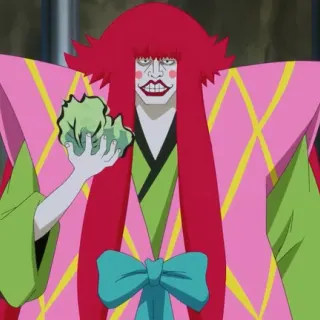
Kanjuro · deceased · the Kurozumi mole among Oden’s retainers; cut down by Kiku Ch. 1014
Profile
A Wano samurai, Kin’emon’s comrade; one of the group of four (three samurai + the boy Momonosuke) bound for Zou before being shipwrecked.
Arc-by-arc updates
Wano Country — Onigashima (Ch. 1044) — posthumous (his dying fire-effigy)
Wano Country — Onigashima (Ch. 1036) — posthumous (his drawn flame-dragon)
- His posthumous drawn flame-dragon, “Burning Hatred,” acts on Orochi’s orders to detonate Onigashima in midair — a “second menace” beyond the island’s fall on the capital, with Yamato in pursuit. (p.7) See Kanjuro’s Kazenbo Eternal Flame Burns Down Onigashima Castle, Onigashima Will Be Dropped On The Flower Capital.
Wano — Onigashima, Kanjuro’s final act (Ch. 1030)
- Still barely alive after Kiku’s @1014 cut, the dying Kanjuro is found in the burning castle by Orochi, who urges him to a “final theatrical encore” depicting “the burning hatred of the Kurozumi clan” (p. 7–9).
- “I shall perform… my final dance… The glorious death of the Kurozumi clan!!” — Kanjuro’s last drawing is Kazenbo, an eternal-flame apparition; he collapses dead (“THUD”) (p. 9).
- Kazenbo glides through walls “like some kind of ghost,” igniting the castle floor by floor (p. 9–10). Kanjuro’s true death is confirmed here. See Kanjuro’s Kazenbo Eternal Flame Burns Down Onigashima Castle.
Wano Country — Onigashima, death (Ch. 1014)
- In the first-floor crawlspace, conjures a mocking fake Oden with his ink-painting power to torment Kin’emon, Kiku, Shinobu and Momonosuke — “I AM ODEN!!! …I’m not your prisoner anymore!” (pp. 4–5, 10–11).
- Reveals he took in the orphaned Kiku and Izo as children: “I’m the man who took you and Izo in!!” (p. 12).
- Cut down by Kiku (“THUNK!!”, p. 12); the wound is fatal. Dying, ties Kiku’s “Fallen Snow” name to Wano’s coming dawn (“if the fallen snow is melting… then surely…”, pp. 13–14) and recalls Oden recruiting “this freak,” declaring “on stage… we were always best of friends!!!” before collapsing (p. 15). See Kanjuro’s Dying Words Read Kiku’s Fallen-Snow Name As A Sign Of Wano’s Dawn, A Spy Hides Among Oden’s Retainers.
Wano Country — Onigashima Raid (Ch. 1012)
- Named as Okiku’s target — she sets out to “vanquish Kanjuro” for good.
Wano Country — Onigashima Raid (Ch. 1008)
- The “Oden” that almost rallies the Scabbards is a Kanjuro painting Kanjuro pilots remotely (“controlling it remotely saps so much strength”); its only flaw is that it bleeds no blood (pp. 5–7).
- Declares his “greatest final act”: “Become Kozuki… bring down Kozuki… then die!!” — and reveals he knows Momonosuke is with a kunoichi, sending the real Kanjuro after the heir (p. 7).
Wano Country — Onigashima rear gate (Ch. 985)
- Holds the Onigashima rear gate against the arriving Kozuki forces; displays “artful” Fude-Fude effigies of decapitated samurai and gloats over Momonosuke’s coming execution (pp. 4–6).
- Battles Kiku and the scabbards with his living drawings (pp. 7–8). (Fruit still un-named on-page.)
Wano Country — Onigashima (Ch. 982)
- Arrives at the banquet as Orochi’s deep-cover agent and presents the bound Kozuki Momonosuke (pp. 4-5); declares his twenty-year acting role complete.
- Tells Momonosuke “now that my role is over, he is merely some child to me” and brands Oden “a fool of a lord” (p. 5).
Wano Country — Onigashima: the lost mole (Ch. 979)
- Carrying the hostage Momonosuke, Kanjuro is lost in the island tunnels of Onigashima and cannot reach Orochi to warn him; the guards read him as just another enemy samurai (pp. 4-5). The raid’s surprise hinges on this failed hand-off.
Wano Country — sea-approach: the mole acts (Ch. 976)
- Acts openly as the enemy mole: secretly reports to Onigashima that he has “completed his role” (p. 5), then snatches Momonosuke from Kawamatsu (“Oh, but I will, fish-man!!”, p. 6) and escapes skyward on a giant painted bird (p. 7).
- Vows to “find Hiyori and kill her” now that he knows Kozuki Hiyori is alive (p. 7).
- Mocks Momonosuke as a gutless “wailing child without conviction” and reveals he delayed the retainers’ deaths “by 20 years, dangling pointless hope” (p. 10).
- Technique — Ukiyo Portrait: Evening Shower (p. 9): paints ink clouds that rain a barrage of ink arrows onto the alliance fleet — keyed to his “Evening Shower” (Yūdachi) epithet.
Wano Country — the spy’s confusion (Ch. 975)
- Shown gripping Momonosuke (p. 2) and inwardly baffled the leak failed — “Did Lord Orochi do nothing to take advantage of my report?! …What is Luffy’s band doing here?!” — the first hint his “Tokage Port” intel was a decoy fed to him (p. 2). His unwitting relay of the decoy is laid out by Denjiro (pp. 14-15).
Wano Country — THE TRAITOR REVEALED (Ch. 974)
- Kanjuro is KUROZUMI KANJURO — a descendant of the main Kurozumi family, born into a popular Wano theater troupe whose parents were killed onstage during persecution within Wano; Orochi killed those responsible and groomed him as a deep-cover spy: “You will die as a Kozuki… you will live your life as a true Kozuki, without a single soul noticing” (pp. 4–5, 10–11). See A Spy Hides Among Oden’s Retainers.
- His “only pleasure is in becoming another person”; he served Oden’s clan as a flawless vassal for 20+ years while feeding Orochi information, and was even willing to die in the boiling-pot execution to complete his “role” (p. 5).
- At Tokage Port he confesses to the scabbards — “My name… is Kurozumi Kanjuro” — that he leaked the alliance’s secrets the whole time: Oden’s failed raid 20 years ago, the embezzled Oden-Castle funds (twice the needed amount), the Zou attack (Jack’s arrival; reaching Zou needed a vivre card he held), and the first plan leak wrongly blamed on Law’s captured subordinates (pp. 5, 10–11).
- He relayed Yasuie’s last-second change of the meeting place to Orochi — rendering Yasuie’s self-sacrifice “officially in vain” (p. 11).
- Painting Devil Fruit escalation: a living self-portrait decoy is exposed — “the Kanjuro we know couldn’t paint that well… A painting?!” (one of two “Kanjuros” is a drawing) — while the real Kanjuro’s secret final act is to abduct Momonosuke and bring him to Onigashima per Orochi’s order (pp. 13–14). (Fruit still un-named on-page.) See Kanjuro’s Secret Final Act Is To Abduct Momonosuke To Onigashima, Kanjuro’s Drawing-to-Life Devil Fruit Introduced.
Wano Country — Oden flashback (Ch. 973) — flashback (youth)
- His drawn steed/bird ferries the group and acts as a decoy for the pursuers (“It’s not a samurai!!”) during the escape (pp. 9–10). Among those Toki casts 20 years forward.
Oden flashback — the Goblin of Kibi (Ch. 962)
Wano Country (Ch. 955)
- Among the samurai who set off for the raid (p. 14).
- (
last_appearance0951 → 0955. FORWARD-GUARD: do NOT hint at any mole/traitor reveal — past-window.)
Wano Country (Ch. 951)
- Moves out from Ebisu Town with Nami’s group after Yasuie’s funeral arrangements — “Nami, Kanjuro, let’s go!!” (p.10).
Wano — Kuri (Ch. 945)
- Present with Kin’emon in Kuri for the reconciliation with Ashura Doji (p. 11).
Wano Country — Ebisu Town hideout (Ch. 938)
- Present at the Ebisu Town hideout (“Master Kan…”); restrains Shinobu — “Stop this, Shinobu!!!” — during the scabbards’ distrust over the leak (pp. 8–9).
Wano Country (Ch. 935) — referenced, not shown
- At the Flower Capital bathhouse, Robin’s group recalls that Kanjuro spoke of Hyogoro the Flower as a man who could rally Wano’s samurai (p. 14).
Wano Country (Ch. 929) — shown; capital intel
- Captioned “Vassal of the Kozuki Clan: Evening Shower Kanjuro”; disguised and gathering intel in the capital, complaining his leads have “dried up” (p. 5). First present-day on-page appearance since the Zou timeskip beats.
Wano Country (Ch. 920) — referenced (flashback)
- Referenced (flashback) as one of the retainers sent 20 years forward by Toki’s power; separated from Kin’emon during the chase after Momonosuke (p. 14). See The Kozuki Time-Leap, Akazaya Nine.
Wano Country (Ch. 919) — mentioned, not shown
- Mentioned only (NOT shown). Named by Kin’emon as one of the five Kozuki who crossed 20 years through time (p. 17; see The Kozuki Time-Leap); his grave stands among the Kozuki gravestones in the Oden Castle ruins (p. 11).
Zou — draws the elephant descent (Ch. 822)
- Volunteers to assist with the “elephant descent” using his drawing ability (p. 14); his art provides the means by which the retrieval team is launched down off Zou to the sea (pp. 15–16).
- (
last_appearanceadvances to 0822.)
Zou — returns to Wano with the samurai (Ch. 820)
- Part of the group returning to Wano (with Kin’emon, Momonosuke and the freed Raizo) to gather samurai for the war on Kaido (pp. 13–16).
Zou (Ch. 818)
- Weeps and begs forgiveness (“Forgive me!!! On my honor… I will work to make this right!!!”); dismisses Raizo’s ninjutsu as coincidence (pp. 2–3).
Zou — Kozuki retainer; reunites with Raizo (Ch. 817)
- Confirmed a Kozuki retainer serving the heir Momonosuke; reunites with the found-alive Raizo at the whale-tree (“Kin’emon!! Kanjuro!!”, p. 13). See Kozuki.
Zou (Ch. 816)
- Recovered and active on Zou; reunites with Momonosuke and stands with Kin’emon as the two visiting samurai whose arrival triggers the dukedom’s uproar (p. 4).
Zou — arrival at dawn (Ch. 815)
- Arrives with Kin’emon. His painting-manifestation Devil Fruit is shown again: he thanks and dismisses a living drawn tiger, “Torasaburo” — “Return to a painting!” (p. 16–17).
Zou arc (Ch. 806)
Zou arc (Ch. 804)
- His drawn dragon Ryunosuke is brought to life to carry the group up the elephant’s leg, then reverts to a flat drawing once the climb is done (p. 5-9). Falls off the leg with Kin’emon.
Zou arc (Ch. 803)
Zou voyage (Ch. 802)
- Aboard the Mister Luffy Go with Kin’emon, bound for Zou (pp. 1–16, among the Wano contingent).
Dressrosa — on the King’s Plateau; the drawing ability shown (Ch. 756)
- On the King’s Plateau (“Flower Hill”) with Kin’emon and “God Usopp.” Introduces himself to the dwarves: “I am Kanjuro the samurai!!!” (p. 5).
- His drawing-to-life ability is shown again — he is drawing a crude “Spring Sparrow” (Kin’emon: “This is a Spring Sparrow, which I will explain later,” p. 4); his work accidentally gets the climbers “spotted,” and he offers ritual harakiri in apology (p. 5). The Devil Fruit is not named. See Kanjuro’s Drawing-to-Life Devil Fruit Introduced.
Dressrosa (Ch. 755)
- The “samurai” whose painted (drawing-to-life) ladders let the freed captives climb out of the scrap-heap pit — though the drawings are so crooked the climbers “can barely climb”; thanked as “samurai” (p. 2). See Kanjuro’s Drawing-to-Life Devil Fruit Introduced.
Dressrosa (Ch. 754) — found alive; Devil Fruit power shown
- First present-day on-page appearance. Team Kin’emon finds him in the “Scrap Heap” beneath the former royal plateau; he had hidden “in the walls” so long he fell asleep, and reunites with Kin’emon (pp. 2–3). Caption: “Samurai of Wano — Evening Shower Kanjuro.”
- His Devil Fruit is demonstrated for the first time: he draws on a surface and the drawing manifests as a living creature — the Spring Sparrow — but his poor art skill cripples it (“can barely fly”) (pp. 4–5). (Fruit not named on-page.) See Kanjuro’s Drawing-to-Life Devil Fruit Introduced.
- Explains the Dressrosa situation to the freed toy-people: the arms-smuggling/toy secrets are exposed, Doflamingo means to kill everyone, the island is sealed off, and there is no way off alive except defeating Doflamingo (pp. 5, 8).
Dressrosa — still captive (Ch. 725)
- Referenced (not shown) as a captive of Doflamingo’s side — Kin’emon worries he is “trapped in that man’s clutches” (p. 6).
Dressrosa (Ch. 713) — referenced; the captive
- Referenced as held prisoner at the “House of Toys”; a Tontatta dwarf petitions Sanji to free him (p. 15). Kin’emon (shown-not-named) likewise urges Sanji to come free his “fellow, Kanjuro.”
Dressrosa (Ch. 705) — referenced; the hostage
- Named only (not shown): Doflamingo’s men hold Kanjuro hostage and threaten his life to make Kin’emon surrender — “if you value Kanjuro’s life” (pp. 13–14). The lone Kin’emon is cornered after his disguise is exposed.
Dressrosa (Ch. 701) — referenced; the rescue target
Dressrosa (Ch. 700) — first appearance
- Shown in Kin’emon’s flashback: he protected Kin’emon’s escape after Momonosuke was taken, and “was taken prisoner” — now held captive at Dressrosa (pp. 10–12).
- Kin’emon praises him as “a REAL MAN” and is “bound by honor” to return and rescue him (p. 19).
Notes
- Etymology — creature-naming motif (Ch. 815): Kanjuro names every manifested drawing as if it were a person, always animal-noun + a stock classical Japanese male given-name suffix, matching Wano’s kabuki/period naming register (and his own “-jūrō”). Tiger Torasaburo = 虎 tora (tiger) + 三郎 Saburō (classic given name, lit. “third son”). Cf. dragon Ryūnosuke = 竜/龍 ryū (dragon) + 之介 -nosuke; cat Nekozaemon = 猫 neko (cat) + 左衛門 -zaemon (Edo-era given name). The suffixes (-nosuke / -zaemon / -saburō) are recurring stock samurai given-name elements — a comedic touch personifying his ink creations. (Dictionary-solid surface meaning; confidence: medium.)