Giolla
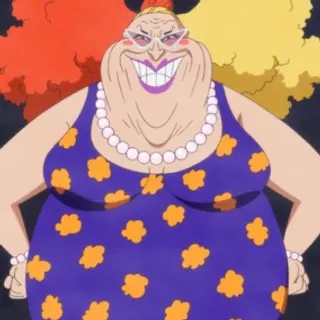
- Name
- ジョーラ (Jōra)
- Status
- alive
- Affiliation
- Donquixote Pirates
- Devil Fruit
- Ato Ato no Mi
- First seen
- Ch. 714
First seenCh. 714Last seenCh. 774
“Jora” · alive · Donquixote Pirates officer (Trebol Army)
Profile
A Don Quixote Family officer attached to the Trebol Army, captioned on debut “Don Quixote Family (♣ Trebol Army) Giolla” (p. 2). A large, art-obsessed woman who flies into a rage at being called a “mermaid princess.” She wields an art-transformation Devil Fruit (power shown on-page, fruit unnamed this chapter) that turns objects and living beings into abstract/cubist “art.”
Arc-by-arc updates
Dressrosa — the factory revival gambit; downed by Leo (Ch. 774)
- At the SMILE Factory / palace punishment room, holds Princess Mansherry captive and forces her to use the Heal-Heal Fruit to revive the defeated Donquixote officers — and has already revived Sugar (p.6-7), aiming for a self-replenishing army (heal + re-toy). See Living Toys of Dressrosa.
- Discovers the healing rides on Mansherry’s tears and tortures the princess to keep her crying, healing one wounded officer as proof (p.9-11). As she begins “round two,” Leo downs her with “Haute Couture: Patchwork” (p.13-15). Running gag: mishears compliments as being called “Boa Hancock” (p.6) / “the prettiest girl of the millennium” (p.9).
Dressrosa flashback — spreads the “white lead is contagious” rumor (Ch. 762)
- Named on-page at the Spider Miles feast as the member who spread the false “white lead is contagious” rumor; corrected by a senior officer — “Don’t embarrass yourself by spouting things you’ve only heard in rumors, Giolla. …It doesn’t spread from person to person.” (p. 4). See Amber Lead Syndrome.
Dressrosa — the Family org chart (Ch. 732)
- Placed on-page in the Family org chart as an Officer of the Trebol Army (“Special Powers Team”) (p. 14).
Dressrosa — the stolen Sunny; the resignation-trap gloat (Ch. 723)
- Aboard the hijacked Thousand Sunny sailing toward Greenbit, she has warped the crew (Brook, Chopper, Nami, Momonosuke) into abstract “art” forms; the crew fight back and strike her, which she calls an “ART-RAGE” (pp. 8–9).
- Gloats that Doflamingo’s resignation was a trap: he “never even quit the Warlords… you have fallen into our trap, you fools!!” and that Violet will have exposed the alliance, whose members “will have been incarcerated” (p. 9). See Doflamingos Resignation Is Eerily Convenient A Hidden Trap.
Dressrosa — the stolen Sunny; felled by Brook (Ch. 722)
- Having hijacked the Thousand Sunny off Dressrosa’s shore, she sails it toward Greenbit, using the Art-Art Fruit to “reawaken her artistic nature” — fusing Nami, Chopper and Momonosuke into a “masterpiece” that would set in ten minutes (pp. 12–16). Captioned “Miss Giolla”; styles herself “for life itself is the greatest work of art.”
- Enthralls Brook (“Soul King”) — but Brook is feigning the conversion: he flatters her into letting him recover the bow/blade hidden in his walking cane, then fells her with “Bamboo Flute Slice” — “Forgive me, I don’t know much about art after all.” (pp. 16–17).
Dressrosa — the Art-Art Fruit named (Ch. 718)
- Attacks the Thousand Sunny off Dressrosa, warping the ship, Nami’s Clima-Tact, Brook’s Soul Solid cane and the crew into “modern art” (pp. 12–14). Her Devil Fruit is named on-page for the first time — the Art-Art Fruit (
devil_fruitset this chapter). - Explicitly disclaims the toy power: “the one who turns people into toys… is someone else in the Don Quixote family!!” (p. 13) — pointing past herself to Sugar. See Toy Transformation Erases The Victim From Everyone’s Memory.
Dressrosa — besieging the Thousand Sunny (Ch. 714) — debut
- First appearance. Attacks the Thousand Sunny in the waters near Dressrosa under “Young Master” Doflamingo’s orders to capture Momonosuke and seize the ship (pp. 2–6): “You must hand over Momonosuke at once!!” (she mentions having seen only “an eel earlier” — his dragon form).
- Her art-transformation Devil Fruit warps the Sunny and its defenders (Nami, Chopper, Brook) into abstract cubist art; by chapter’s end the ship “isn’t even a ship anymore” (p. 6).