Klahadore
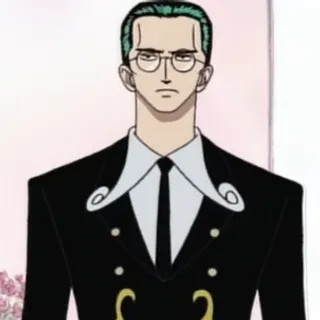
- Name
- クラハドール (Kurahadōru)
- Status
- alive
- Affiliation
- Black Cat Pirates
- Bounty
- ฿16,000,000
- First seen
- Ch. 23
Butler of Kaya’s mansion · first appearance in pure silhouette · “Yes, Mistress Kaya?”
Profile
Butler of Kaya’s mansion. First appearance in pure silhouette in Ch. 23 (p. 19, final two panels): tall figure, butler’s posture, reflective round-glasses rendered as gleaming discs, slicked-back / cup-handle hairline. Named once in a reaction-word lead-in on the same page (“Klahadore…?”); speaks one line — “Yes, Mistress Kaya?” — in response to Kaya’s request to see Usopp. The silhouette has two specific tells that pay off in subsequent chapters: the polished round glasses (Captain Kuro’s signature shtick) and the cup-handle hairline (Kuro’s signature haircut). Both are legible on-page in Ch 23 before the reveal lands. Standard Oda villain-introduced-by-silhouette-before-face grammar.
Arc-by-arc updates
SBS paratext (Ch. 65) — Canonized as #2 IQ character in the series (SBS Q&A page 18)
Syrup Village (Ch. 41) — Referenced by negation only — “About Klahadore?” “No.” (page 14)
- Referenced once, by name, in a negation (page 14, panel 5): Merry asks Kaya “About Klahadore?” — Kaya replies “No.” The villain’s name is invoked only to be not the subject of the woods-walk monologue. The compositional choice signals that Klahadore is no longer the household’s organizing concern — Usopp’s backstory now takes that role. The arc’s villain is structurally past the village’s narrative attention. Status at chapter close: still off-page since Ch 40 ejection; no on-page confirmation of fate; the villain has been moved past by the surviving cast.
- The villain-past-tense register is the chapter’s quietest moral move — the arc completes when the survivors stop talking about the villain.
Syrup Village (Ch. 40) — Arc-finale: defeated by Luffy’s final Gomu Gomu strike; ejected from the village as “garbage” (unnamed by Luffy)
- Defeated by Luffy’s final Gomu Gomu strike (page 2 — “WHAM!!!”); embedded in the rock formation behind him. The Ch 39 cliffhanger (Usopp’s bell-strike, Kuro stunned but upright) resolves into Ch 40’s Luffy-finisher landed.
- Cat witnesses narrate his epithet — “Kuro of the Thousand Plans, the man who outfoxed the Navy!” (page 3). The local fauna validate the human-scale feat the village will never know about; the witnesses are non-human because the human witnesses (villagers) are intentionally absent per the cover-up.
- Asks “Who are you?!!!” — receives Luffy’s King-of-the-Pirates self-declaration in response (page 4). Second on-page Luffy “I’m Monkey D. Luffy… King of the Pirates” declaration to a defeated villain (first instance Ch. 18 to Buggy). Pattern formalized as recurring ritual.
- Kicked off-frame with “SHOOM!! Take your garbage with you!! And don’t ever come back!!” (page 5). Status post-ejection: unshown / ambiguous on-page. Luffy names him garbage rather than naming him by name — a moral hierarchy choice. Compare Ch. 18 Buggy defeat: Buggy is named by Luffy (“You’re not Captain Buggy, you’re just Buggy!”). Kuro is unnamed — he gets “garbage”. The naming difference encodes a moral distinction: Buggy is a pirate, Kuro is a fake pirate / butler-impersonator who would kill a sick girl for money. The naming asymmetry is the chapter’s quiet moral verdict. Cross-link Luffy Refuses A Kind Of Pirate — Ch 40 is the operational ejection corresponding to the Ch 39 “a pirate like YOU” refusal.
- Status at chapter close: defeated, ejected off-frame, physical fate ambiguous on-page (the chapter does not show him post-ejection). Status retained as alive per NO-DOWNGRADE — the kick is comedic-ejection in tone, not lethal-finisher composition; the Ch 26 Bara-Bara-of-Buggy precedent for defeated-villain-survives holds.
Syrup Village (Ch. 39) — Three-year plan structurally broken on-page; “I may be a murderer, but I’m a man of my word” axiom verbalized seconds after breaking it; “MY PLAN CANNOT FAIL!!!”; bell-strike from Usopp at chapter close
- Chokeheld out of Stealth-Foot speed-blur by Luffy (page 7 bottom, SWAP SFX). Luffy grabs Kuro mid-blur from behind in a chokehold; Kuro’s signature speed-mechanic is voided by being gripped out of motion. “Now try your fancy footwork!! I WON’T LET YOU!!” — first on-page beat where Luffy grabs a speed-blur enemy out of motion. The Ch 37 snap-the-weapon + Ch 39 chokehold-the-speed combat-grammar pair confirms Luffy’s tactical answer-pattern to Kuro: neutralize the signature mechanic, not out-power it.
- Three-year plan structurally broken on-page (page 16): Luffy in the chokehold delivers “Now your three-year plan is a FAILURE!!” — cliff-edge silhouette composition, the chapter’s structural turning point. The villain-plan-named-at-the-moment-of-its-collapse beat. Kuro’s character-defining obsession across the arc dies in this chapter — though Kuro himself is not yet defeated (chapter ends mid-fight). Reinforces Kuro Three Year Plan and Captain Kuro’s Plan — the plan is terminated at this beat.
- Will is signed and read aloud on-page (page 11): “I leave all my entire fortune to my butler Klahadore.” The contractual MacGuffin Kuro spent three years engineering is executed in front of the reader — the Klahadore alias inherits the fortune legally. Then immediately voided by Kuro’s own response: “Now you have to die. This will’s no good… as long as you live.” The chapter shows the signed paper working exactly as planned and the spoken promise (to spare the children) being broken in the same beat. The legalist-villain’s plan-execution succeeds on the document; the legalist-villain’s word is empirically worthless.
- Villain-thesis axiom verbalized — “I may be a murderer, but I’m a man of my word” (page 11). Delivered seconds after he breaks his word to Kaya about sparing the children — he said “All right… the brats can live” on page 9, then on page 11 reads the will and announces “Now you have to die”. The villain’s self-mythology is structurally a lie; the chapter is its empirical refutation. The honor-coded murderer whose honor is empirically a lie archetype is on full display — the Kuro line is the originating instance of the villain-self-mythology-as-load-bearing-lie pattern that recurs across the series (Crocodile, Lucci, Doflamingo). See Villain Honor Is Empirically A Lie (new this chapter).
- “MY PLAN CANNOT FAIL!!!” (page 17, extreme close-up, teeth bared, sweat streaming, RERK/THWAK SFX punctuating). Twice repeats “…my plan…” in the same page. The villain-collapses-when-his-plan-fails archetype is on full display: Kuro’s identity is so plan-bound that the plan’s visible failure causes a personality break. First on-page instance in the series of the plan-equals-identity villain archetype. Recurs structurally in Crocodile (Operation Utopia), Hody (New Fishman Island), Doflamingo (the Birdcage), every later “mastermind” antagonist. See Villain Plan Equals Villain Identity (new this chapter). The plans-vs-instinct axis is staged in this chapter as direct contrast — Luffy’s “plan” is “SHOW YOURSELF, BUTLER!!!” / “GOTCHA!” while Kuro’s “MY PLAN CANNOT FAIL” face is the chapter’s character-collapse panel.
- Receives Luffy’s “I’m never going to become a pirate like you” verdict (page 7 top, closed-eyes/grim-set-face Luffy). The Ch 37 disqualification verdict (“You shouldn’t be a pirate!!!!”) and the Ch 39 negative-definition verdict (“a pirate like YOU”) compose Luffy’s full moral judgment of Kuro across two chapters. Kuro is now both disqualified from the pirate-identity (Ch 37) and named as the anti-template Luffy refuses (Ch 39). See Luffy Refuses A Kind Of Pirate (new this chapter).
- Crew jeers him mid-fight (page 17): the Black Cat Pirates rank-and-file rendered as grinning, fist-pumping silhouettes — “KILL CAP’N KURO!!! Yeah! Get him, rubber boy!!!” — physically arrayed against him in the panel. The pawn-sacrifice plan has destroyed crew loyalty even while Kuro is still alive. The Ch 38 crew-as-pawns doctrine monologue has its operational cost on display in Ch 39: the crew the captain treats as pawns will not be loyal. Cross-link Kuro Crew As Pawns Doctrine and Loyalty to Dead Master Pattern (contrast payoff Ch 39 entry).
- Berates wounded Buchi and Sham on the cliff (page 6): the “suffering instead of dying quickly” monologue is delivered to the pawns Kuro can see crumpled on the rocks behind him. “Look at this. It’s all YOUR fault.” / “…my poor pawns are suffering.” — the villain’s moral inversion is visible in panel composition: he reads the wounded pawns as Luffy’s wrongdoing, not his own. The villain’s blame-displacement is operationally on-page.
- Cat-claw false-strike on Luffy (page 4, SHINK!!) — appears to gut Luffy across the chest in a violent diagonal strike, blood spraying. The SHINK SFX dominates the page. Bait-and-reveal: Luffy backflips clear on page 5 (WOOSH!! + GOTCHA!) — the slash was connecting on a stretched-elongated rubber body that absorbed the cut without damage. Reinforces (and slightly softens) Rubber Cannot Withstand Blades — rubber-stretched may survive blade cuts that rubber-static cannot.
- Bell-strike at chapter close (page 19, SHOWONK!!) — Usopp swings Kaya’s brass call-bell into Kuro’s head. Reaction: !!!? The chapter title (“For Whom the Bell Tolls”) pays off literally — Kuro is the thee in the Donne/Hemingway sense. Status at chapter close: stunned, conscious, mid-fight; the Pussyfoot-Maneuver / Out-of-the-Bag recovery is pending.
- Note for synthesizer: Kuro’s prototypical “honor-coded murderer whose honor is empirically a lie” archetype is now installed across two consecutive chapters (Ch 38 crew-as-pawns doctrine; Ch 39 “I’m a man of my word” axiom). The archetype recurs in later villains (Crocodile, Lucci, Doflamingo) — flag as cross-link target for future villain-classification work.
Syrup Village (Ch. 38) — Recovers from Ch 37 KO; full villain-thesis monologue (crew-as-pawns doctrine); reveals plan was always to kill his own crew; Mr. Klaw name-taboo enforced on the slope; Out-of-the-Bag attack named/dread-built/deployed; begins slashing his own crew indiscriminately
- Chapter opens with Kuro collapsed at Luffy’s feet (page 2 — “BOOM!!” SFX, three of Kuro’s gleaming claws shattered and scattered, Luffy standing center-frame on rubble). The Ch 37 chapter-end KA-WHAM uppercut has lifted him off-frame; Ch 38 page 2 stages the aftermath — Kuro has fallen but is not unconscious. Recovers within the page. The Ch 37 plan-was-to-destroy-Captain-Kuro verdict (Luffy: “You shouldn’t be a pirate!!!!”) is not yet accepted by Kuro — he stands back up to fight again.
- Five sword-claws remaining (page 2 — Luffy: “Now you only have FIVE sword-claws!”). One full set of cat-claws is destroyed in the opening; the other set remains (referenced at page 13: “don’t get cocky just because you broke my claws”). The hand composition is the chapter’s character-portrait shot for Kuro — butler suit + clawed pirate weapon, the visual contradiction of the character in one image.
- Enforces the Mr. Klaw name-taboo on his own crew (page 3 — “Shut your gobs! I’ll deal with you dogs later. And that goes for Django, too.”). His own Black Cat Pirates rally with “Cap’n Kuro’s Cat Claws!” but immediately stumble on the village-nickname “Mr. Klaw”; Kuro hisses the rebuke; his own crew freezes (“WHY US TOO?!”); the meta-warning “You’re not supposed to call him… THAT NAME!!” is voiced. Pattern-match with Buggy Nose Taboo / Buggy Officers Vanity Taboo — second East Blue villain-captain to enforce a personal-vanity speech-rule. Structurally distinct because the taboo is on a cover-identity (the Klaw village-alias), not a body-feature (Buggy’s nose). The taboo’s psychological reading: the Klahadore persona is psychologically painful — the cover was emotionally costly to maintain (see Kuro Servant Hatred register from Ch 34). The taboo also has an etymological layer — the village’s Klaw mangling is closer to Kuro than the cover-alias Klahadore itself (Kura → Klaw → Kuro) — the corruption is etymologically threatening to bridge the cover and the real name. See Kuro Klaw Name Taboo (new this chapter) and Pirate Captain Vanity Taboo Pattern (new this chapter — the cross-villain meta-pattern tracking Buggy + Kuro and forward to Crocodile / Doflamingo / Big Mom / Kaido / Blackbeard).
- Reveals that the three-year plan always included killing his own crew (page 10 — “I never intended to let ANY of you leave here alive. I can’t let anyone live who knows my true identity.”). The Black Cat Pirates’ presence at the village shore was not a temporary alliance — Kuro intended to murder them on the slope once Kaya’s death was confirmed, to erase witnesses. The Ch 35 reflex-murders own crewman register is now contextualized as consistent with the plan from the start, not a battlefield improvisation. The henchmen’s panic — “If Django makes that girl write her will, your plan will succeed!!” / “It’s not too late to attack the village, right?!” — is them attempting to negotiate for their own lives by reaffirming their utility; Kuro’s response is the chapter’s villain-thesis monologue. Reinforces Kuro Three Year Plan and Captain Kuro’s Plan.
- Articulates the crew-as-pawns villain-doctrine in a two-page monologue (pages 11-12): “Pirates are wild dogs, society’s cast-offs. Without a leader, they’re helpless. They should live or die by my command. Pirates should be faithful pawns of their captain. They should have died trying to fulfill my plan!! They should have followed my plan no matter what sprang up to impede them. Vagabond brats should keep their smart mouths shut!!! That’s the way of the pirate!!!” First complete on-page articulation of the crew-as-pawns doctrine in the series — the precise structural inverse of Luffy’s captain-fights-for-crew’s-dreams thesis. The chapter is structurally a villain-thesis chapter; the plot stops to let Kuro state his organizing principle, and Luffy answers it one page later (“Don’t you care about your own crew?!!” — page 21). See Kuro Crew As Pawns Doctrine (new this chapter) — predicts every later major villain captain will articulate a structurally identical inverted-Luffy crew-thesis (Krieg, Arlong, Crocodile, Doflamingo, Big Mom, Kaido, Blackbeard). The chapter is the East Blue villain-thesis chapter at the crew-management layer, paralleling Morgan’s villain-thesis at the self-image layer.
- Receives Luffy’s “It’s your style!” punch + PLINK glasses-tilt (page 14): “It’s your style! You don’t even look like a real pirate!!!” → WHAK → PLINK SFX as Kuro’s glasses snap askew. The cover-identity prop (the glasses) is the first thing to break under the captain-on-captain hit. Compositionally: Luffy hits the disguise first, then the man. Companion-evidence to the chapter’s style-vs-identity-insult grammar — Luffy’s most cutting insults to villain captains attack their aesthetics (Kuro’s butler look = first clean instance, recurs for Crocodile, Doflamingo, Big Mom).
- Drops into the Out-of-the-Bag stance (page 16 — full-page silhouette panel, SLUMP SFX): Kuro’s full-figure black silhouette, arms hanging, claws drooping, head down. “I’ll show you the ferocity of a pirate who’s faced a thousand deaths!!!” His crew recoils and names the stance (“That stance! It’s… it’s— It’s the Out-of-the-Bag attack!!!”). First named on-page finisher-tier Kuro signature attack. The attack is composed entirely through other characters’ reactions — the technique-named-before-shown introduction-grammar in textbook form. See Kuro Out of the Bag Attack (new this chapter) — predicts the same introduction-grammar will recur for Mihawk (Ch ~50-51), Crocodile’s first Sables, Kuma’s first paw-deflection, Kaido’s first Bolo Breath. The grammar is Oda’s high-tier-combatant introduction template in its originating instance.
- The crew begs not to be killed by the attack (page 17): Black Cat ex-crew on knees, hands raised, begging. “If you let me live, by all that’s holy, I’ll never breathe a word about you being alive!!” / “C-Captain Kuro!” / “We’ll do whatever you say!!!” The crew knows they’re already dead — the moral-floor-collapse beat of the chapter. The crew-loyalty-via-terror register from Ch 32 is now in its terminal phase: terror without operational utility, terror as countdown.
- Deploys the Out-of-the-Bag attack (page 19 — “SLASH!! It’s begun!!!”): Kuro turns into a high-speed indiscriminate blur, slashing his own former Black Cat crew apart along with the cliff walls. “He’s moving so fast, even HE doesn’t know what he’s slashing!!” (page 20). His own crew is being cut down indiscriminately while screaming “Captain Kuro, please stop!” (page 20). The attack is self-blinded saturation — Kuro is not aiming, the crew is the target field as much as Luffy is. The technique’s first deployment is on his own crew. The plan from the start (kill all witnesses) and the signature finisher (self-blinded slash-field) are revealed to be operationally the same thing: the Out-of-the-Bag attack is the plan’s execution mechanism, not just a combat technique. The Ch 35 reflex-murders own crewman register escalates to systematically murders own crew at scale.
- Combat speed established at a level his own former subordinates can’t track (page 20). The Out-of-the-Bag attack’s speed is established as beyond his own ex-crew’s ability to track — even his own former subordinates, who were trained to follow him, cannot read the motion. Only Usopp can track the move (page 15 — “He tracked the captain’s creeping cat move!”). The chapter establishes a combat-speed hierarchy: Black Cat ex-crew < Usopp’s sniper-perception. Note: the Creeping Cat sub-technique on page 15 is the windup / footwork before the Out-of-the-Bag deployment — the named footwork that the named attack discharges from.
- Cover-identity register absent for most of the chapter — Kuro is on-page as pure Captain Kuro throughout; the Klahadore butler-name is not spoken by anyone in this chapter (the Klaw mangling is the only reference to the cover-identity, and is the taboo-trigger). The Ch 37 Captain-Kuro-register-only pattern continues into Ch 38. Luffy calls him “butler!” once at chapter end (“Show yourself, butler!” — page 21, panel 1) — first time in the chapter the butler-register is acknowledged on-page; Luffy is using it as a summons, not as an address, suggesting the butler-identity is what Luffy fundamentally sees through.
- Status at chapter end: alive, mid-attack, still slashing indiscriminately; the Out-of-the-Bag attack is not yet resolved. Luffy is upright with the “Don’t you care about your own crew?!!” roar staked as the chapter’s moral counter-thesis. The chapter’s structural cliffhanger: can Luffy stop a captain from murdering his own crew? The combat is unresolved; Kuro is not yet defeated again.
Syrup Village (Ch. 37) — Named on-page as Captain Kuro for the first time; epithet “Captain Kuro of the Thousand Plans” established; full three-year-prior backstory monologue; bladed cat-claws on-page in close-up; claws broken by Luffy; chapter-end KO verdict
- First on-page named appearance as “Captain Kuro” — the chapter title and the in-dialogue references both name him directly; his full epithet “Captain Kuro of the Thousand Plans” (千の悪知恵を秘める) appears as the flashback caption-block on page 11 panel 1 (“CAPTAIN KURO OF THE THOUSAND PLANS (THREE YEARS AGO)”) and is reused in Kuro’s own monologue (page 16). The Klahadore-name does not appear in this chapter — Ch 37 is the pure Captain-Kuro register chapter, the inversion of the Ch 23-32 pure Klahadore register chapters. The two registers Kuro has been operating across the arc are now fully separated on-page: Ch 23-32 is the butler; Ch 33-36 is the butler-revealed-as-captain dual-name beat; Ch 37 is captain only, with the butler register entirely absent.
- Detonates in rage when Django publicly cheers him by name (page 8): “Hooray for Captain Kuro!!!” (Django) → “NEVER CALL ME BY THAT NAME!!!” (Kuro, full-rage close-up, mouth-open, glasses-and-teeth dominating the panel). The name-as-trigger beat cues the entire chapter’s flashback cascade — Kuro’s identity is so structurally hidden in his own psychology that hearing it spoken in public is the chapter’s first emotional rupture in him. The Ch 26 “I discarded that name three years ago” register (cold-rejection-of-the-name) is now staged as hot-rejection-of-the-name-being-publicly-celebrated.
- Three-year-prior backstory monologue on-page in full (pages 9-16). The flashback fills the chapter’s middle: three years ago Captain Kuro of the Thousand Plans sat alone reading in his cabin aboard the Black Cat Pirates’ ship, announced to Django “I’m leaving this ship” (page 11), and articulated the motive — “It’s our reputation that draws these sharks!” (page 12 panel 2) → “Captain Kuro has outlived his usefulness” (page 12 panel 2) → “Then I’ll die. And the whole world must know it” (page 12 panel 4). Three new motive components are now on-page: (a) the fame-as-trap axis (reputation draws hunters), (b) the renunciate-villain posture (he wants OUT of piracy), (c) the two-goal motive structure (“wealth and peace of mind” — page 16 panel 4) versus most East-Blue villains’ single-axis motivation. The Ch 26 plan-exposition (to Django, in present-day) and the Ch 34 plan-monologue (to Kaya) are now joined by the Ch 37 backstory-monologue register — the chapter is the origin-story-as-villain-flashback beat.
- Death-fakery method on-page (pages 13-16): Kuro rowed alone to the Marine warship that was bombarding the Black Cats (small figure in rowboat under the moon, page 13), single-handedly massacred its entire crew (page 14 wide horizontal of bodies strewn across the deck, Kuro alone among them in middle distance, moon overhead — the chapter uses the cut-to-after technique, not showing the massacre in progress to make the threat feel larger), selected a still-breathing prisoner with “a nice face” (page 15 panel 4) “through a broken jaw” (one of the most quietly horrifying lines in early One Piece — Kuro selects his death-double while breaking the man’s jaw, and the man’s responsive speech is what convinces him the plan will work), then hypnotized the surviving Marines through Django (“My name is Captain Kuro. My name is Captain Kuro.” page 16, three-panel chant) into believing the prisoner was Kuro and Django was the captor. The three-component mechanic is now on-page: (1) a body that can pass for Kuro, (2) a hypnotic rewrite of witness memory, (3) a credit-handoff to a co-conspirator who appears to be the captor. The Ch 26 “And we helped spread the rumor that you’d been executed” (Django’s narration) is now staged in full: the rumor was the witness-memory-rewrite via hypnosis; the execution was the impostor’s. Reinforces Kuro Faked Execution (now backstory-on-page in the villain’s own voice).
- First on-page combat against Luffy as Captain Kuro register (pages 2-19). Composition: empty grassy bluff outside Syrup Village, western-style high-noon standoff (page 2 wide horizontal — Kuro left, hands in pockets, suited; Luffy right, fists up; Black Cat Pirate crowd “OOOOOOOOO” SFX filling the upper sky). Kuro: “DIE.” / Luffy: “NOT TODAY.” The bluff is implicitly continuous with the Syrup Village Beach / north-slope geography of Chs 32-36 but staged as a grassy field — chapter sites itself on the village-side of the slope (i.e. past the slope chokepoint). The kids/Kaya/Usopp/Zoro/Nami sub-plot from Ch 36 is off-page the entire chapter — Ch 37 is the solo-Luffy-vs-Kuro-finale-fight in pure form.
- First on-page speed-archetype combat-mode (pages 2-8): afterimage / multi-position composition with “FWIP / WUP / TMP TMP TMP” SFX (page 3). The Black Cat crew reads him as a near-teleporter (“There they go!” — page 2 panel 4). Beats Luffy off the launch of a Gum-Gum Pistol — “GUM-GUM…” never finishes the attack-call (page 4 panel 4), Kuro lands a kick on Luffy’s head while naming the kick “PISTOL!!!” (page 5 panel 1, “WHOMF” SFX). First on-page villain-mocks-protagonist’s-attack-call beat — Kuro takes Luffy’s move-name and applies it to himself as verbal mockery. Luffy snags Kuro’s collar mid-recoil and yanks him into the ground; Kuro stands on Luffy’s outstretched arm casually balancing, drawling “You bore me, boy” (page 6) while the Black Cat crowd panic-cheers (“He’s standing on his arm!!!”). First on-page humiliation-of-Luffy beat — the villain treats the protagonist as furniture; the pattern recurs at every later mid-fight low-point in the series (Crocodile, Lucci, Kaido, Doflamingo). See Speed Archetype First On-Page (new this chapter).
- Cat-paw bladed claws on-page in close-up for the first time (page 18 panel 1). The cat-claws Ch 30 seeded via “CHAK CHAK” hand-glint and Ch 33 staged as named-weapon combat-mode are now rendered in close-up-against-Luffy’s-crossed-arms with the “CHINK” SFX (page 18) — Luffy takes the cuts on his rubber arms (mouth open in pain, “UNGHAAA!!!”); the Rubber Cannot Withstand Blades vulnerability holds in this chapter as well. The Black Cat Pirates’ crew name is now visually anchored on the captain’s weapon-shape in a single panel — see Crew Name Encodes Captain Weapon (new this chapter).
- Claws broken by Luffy (page 19, panels 1-2): Luffy closes the distance and snaps the claws by reversing the leverage on Kuro’s arms. “KLAK” SFX; “YARR!! HE BROKE THE CAPTAIN’S CLAWS!!!” — chapter’s combat-resolution panel. Even the villain’s own crew can read this as the fight ending. The Ch 18 Bara-Bara-vs-rubber anti-cutting rule from Buggy is not contradicted here; Luffy’s tactical response is take the weapon out of the equation by closing distance, not tank the blades with rubber. First on-page snap-the-weapon move in the series; the technique recurs in later arcs (Don Krieg’s vest-bisento, Crocodile’s hook, Lucci’s tekkai, etc.). Companion-evidence to Rubber Cannot Withstand Blades.
- Mocks Luffy’s training, gets answered with the chapter’s “I’ve been training” admission (page 19, panel 2): Kuro “So. Stretching isn’t your only talent” → Luffy “Nope! I’ve been training!” — first on-page Luffy confirmation that there has been a training gap between Ch 1 (the Foosha boy) and the present. Oda asserts the training without showing it — the chapter is willing to claim training as a fact without staging a training-montage. Sets the template for every later off-screen-training-gap admission in the series (Boin Archipelago, Two-Year skip, etc.).
- “My plan is to utterly do away… with CAPTAIN KURO!!!” (page 17, two-panel split — Kuro’s standing silhouette + zoomed-in glasses) — the chapter’s thesis line. Kuro is literally above Luffy in the composition (downed Luffy on the ground, Kuro on the bluff above) — visual hierarchy is villain wins until the next page. “There’s no room for error in my three-year plan” (page 17) restates the three-year-plan framing in his own voice for the third arc-chapter running (after Ch 34 and Ch 35).
- Chapter-end KO and verdict (page 19, panels 3-4): Luffy “And if you wanna compare plans, mine’s much bigger!!! …You shouldn’t be a pirate!!!!” + “KA-WHAM” uppercut to Kuro’s chin lifts him off-frame. First on-page Luffy verdict on another character’s pirate-identity — see Luffy Judges Pirate Identity (new this chapter). The chapter awards the captain-finish to Luffy but couches it in a moral-identity verdict: Kuro is disqualified not because he’s outmatched but because he quit piracy — being a pirate is a moral commitment, not a tactical position. Luffy delivers the line while smiling (chapter’s third Luffy-smiles-mid-finisher beat after Alvida + Buggy); the smile-while-finishing motif is now canonical Luffy combat-grammar.
- Stated motive structure on-page: “wealth and peace of mind” (page 16 panel 4) — first East-Blue villain whose stated motive is to stop being a pirate. Mirror-villain composition against Luffy’s “King of the Pirates” ambition (Ch 1); the chapter’s structural reveal: Luffy’s verdict (“You shouldn’t be a pirate!!!!”) agrees with Kuro’s self-assessment but reframes it as the disqualifying offense. The want-out-of-piracy-as-villain-tell template is now installed; recurs structurally in later antagonists (Crocodile wants to stop being a Warlord, Doflamingo wants to stop being human, etc.).
- Pussyfoot Maneuver not named in this chapter — the warp-step technique that Ch 33 named and Ch 36 deployed against Luffy/Zoro/Spear is not in Ch 37’s combat vocabulary; the speed beats here are afterimage-only and unnamed, suggesting the Pussyfoot Maneuver is a higher-gear technique Kuro is not using against Luffy in the open field. The afterimage speed here is Kuro’s baseline speed, not his combat-mode-warp-step.
Syrup Village (Ch. 36) — First face-to-face with Luffy; first on-page warp-step (proto-Soru); restates Kaya-as-pawn plan; reads the recruitment-pattern question to Luffy
- First face-to-face with Luffy on the village’s north slope (Syrup Village Beach — Syrup Village North Slope alias) — hands in pockets, cat-claw gauntlets implied via the long curved blade-extensions on page 18 panel 2. The Ch 35 plan-redirection-mid-combat register transitions into the Ch 36 direct-confrontation register: Kuro is now operating against Luffy personally, not via lieutenants.
- Confirms Kaya-as-pawn plan and wait-for-her-to-die clause (page 6): “As I said, Kaya was a pawn I needed to further my plan. When she dies, then I’ll say my thanks. Not an ounce.” The Ch 26 plan-exposition (to Django) + Ch 34 plan-monologue (to Kaya) + Ch 35 plan-redirection (will-forgery to Jango) are joined by the Ch 36 plan-confessed-to-the-opposing-captain register. The wait-for-her-to-die-clause is fixed as a plan step, not a contingency — Kuro will not personally kill Kaya until she dies on her own from his arrangement. The legalist-inheritance grammar from Ch 26 holds: legitimate succession is the deliverable, not just death.
- First on-page warp-step (page 8, TA-TUMP; page 16-18, KLINK/SHWOOM/GRRRR) — vanishes from a fixed position and re-materializes elsewhere with no in-between motion, sound-effect-bridge composition. Demonstrated twice in this chapter. Not named in-dialogue (the Pussy Foot Maneuver / Out-of-the-Bag Attack naming is forward to later chapters). Escapes the Luffy/Zoro double-engagement (page 8) and dodges Luffy’s Gum-Gum Spear (page 17). Visually identical to the later Soru/Shave technique of the CP9 Six Powers — Kuro is a likely proto-Soru archetype. See Kuro Pussy-Foot Maneuver (new this chapter).
- Asks Luffy the recruitment-pattern question (page 19): “Why are you, an outsider, sticking your neck out for this village?” with a smile. Reads as a villain who understands Luffy’s moral grammar and finds it amusing rather than threatening. Receives the captain-side single-clause answer (“I don’t want you to kill.” page 20). Kuro’s response: “Ah. How simple. Is it enough… to die for?” — the smile + “How simple” register frames the chapter’s villain-thesis: Luffy’s moral grammar is legible but underestimated by the legalist villain. The villain-credits-the-recruit-pattern beat from Ch 35 (Jango crediting Usopp’s tactic) is now joined by the captain-class-villain-acknowledges-the-protagonist-captain’s-moral-grammar beat — the recruitment-pattern question is the frame both captain-class antagonists are now operating against.
- Materializes at the kids’ position (page 21): “So here you are.” — chapter-closing arrival on the fevered Kaya + the Usopp Pirates kids. Kuro has tracked the escape vector via warp-step and is now at the kids’ position with the wait-for-her-to-die axiom and a fevered target. The chapter-end composition stages the wait-clause and the fever-collapse on the same panel — Kuro’s plan-arithmetic suggests he can simply wait.
- Names Django as the off-page hypnotist (page 5): “It’s probably Django, finishing off your friends. Go see for yourself, though you may be too late…” — Kuro’s cold-affect murder-utility-calculus register continues unchanged. The Ch 26 “From that height, he’s dead for sure” and the Ch 35 “They’ll never escape Django!!” combat-assessments are now joined by the Ch 36 “…though you may be too late” register — Kuro reads enemy-survival arithmetic with the same cold accuracy he reads ally-survival arithmetic.
- Speaks in clipped declaratives throughout — same speech-grammar register the chapter establishes via the “Who gave you permission to climb this slope?” (page 14) and “So here you are.” (page 21) bookends. The legalist-villain register holds: short sentences, precise word-choice, no rhetorical excess. The Ch 33 cap’n-vs-Captain-Kuro register-split is now resolved into short-declarative-captain-Kuro combat-mode register.
Syrup Village (Ch. 35) — Survives Luffy’s KO; reflex-murders own crewman; deduces Luffy’s DF; states the will-forgery plan in his own voice
- Survives Luffy’s earlier KO blow (pages 2-3): wakes face-down in the slope path, far inland from the beach where the punch was delivered — the chapter opens with the Black Cat crew clustered around him in horror (“WHAT WAS THAT!!? THAT KID! HE SENT CAP’N KURO SAILING!!” / “FROM ALL THE WAY OVER THERE!?” page 2). Rises slowly with a “Krak Krak” neck adjustment (page 3) — the unflustered villain getting up after the protagonist’s signature attack template. The Ch 34 chapter-end “Captain Kuro is DOWN!!” status is now recovered-but-displaced; the cliffhanger pays off as a distance-knockback gag, not a finishing kill.
- Reflex-murders his own crewman to reach the Usopp Pirates kids (pages 6-7): when his own Black Cat crewman intercepts (“YOU IDIOTS!! GET OUT OF HERE!!!” page 6) to physically protect the kid-crew from Kuro’s drawn claws, Kuro cuts the crewman down with the same swing aimed at the children (“FWUMP” page 7, “CAPTAIN!! OOF!!”). Walks past the still-stunned Usopp Pirates kids and his own dying crewman without engaging either (“HEY, HE WALKED RIGHT BY US!” page 7). The chapter’s cold-affect register is fully on-page. First East Blue villain whose reflex under threat is to liquidate even allies. See Crew Loyalty via Terror Inverse — the terror-not-loyalty command-structure now grounded in captain-actually-kills-his-own-when-they-obstruct-the-plan.
- Acknowledges Luffy as a Devil Fruit user (page 8): “You must have the power… of the Devil Fruit!!” — deduces from observation. Continues the empirical-deduction template established with Buggy. Cross-link Gomu Gomu no Mi.
- Articulates the Plan in his own voice — will-forgery + Kaya-kill + clean-slate witnesses (page 9): “You just deal with Miss Kaya! Force her to write the will, as we planned, then… kill her!!! I’ll kill the Gum-Gum Man!”. The deliverable is a forged will, not just Kaya’s death. The three-year butler cover identity is justified as the time required for a forged-will-by-the-trusted-servant play. Also targets the Usopp Pirates kids (“those three nipping pups, too…”) — confirming the plan’s clean-slate witness-clearance requirement. This is the chapter where the Ch 26 plan-exposition (to Django) and the Ch 34 plan-monologue (to Kaya) are joined by the Ch 35 plan-redirection-mid-combat register — the will is named as a deliverable, not just an objective. Reinforces Kuro Three Year Plan and Captain Kuro’s Plan.
- Threat-rates Buchi correctly (page 13): “Doesn’t know own strength.” — Kuro’s terse profile of his own officer’s raw force combat profile. Same character-grammar as Ch 33 (Kuro reads his own crew’s combat-state with cold accuracy).
- Knowledge of Kaya’s medical condition (page 19): “I, more than anyone, know how frail that girl’s body is…” — implies intimate knowledge of her physiology. Open question: is Kuro causing her frailty (slow poison, withheld medication during his three-year butler tenure), or just exploiting it? Chapter doesn’t say.
- Role-split with Jango (page 9): Kuro takes Luffy; Jango takes Kaya. The captain-class-takes-the-captain pattern from Ch 34 (where Kuro took Luffy directly and lost to Usopp’s tackle) now operates with role-allocation — Kuro keeps the Luffy slot but delegates Kaya to his lieutenant. The chapter’s combat-allocation reasserts the Ch 25-vintage Klahadore-superior/Django-subordinate chain-of-command.
Syrup Village (Ch. 34) — A Humble Servant: the butler-mask permanently dropped; punched flat by Luffy
- The chapter title is Kuro’s own line — “A Humble Servant” — and Kuro uses the exact phrase “I was ever your humble servant” on page 16. The entire speech inverts the meaning: read first as a descriptor of Klahadore the butler, read retrospectively as Kuro’s own self-mockery of the three-year disguise. See Kuro Servant Hatred.
- Both aliases are spoken on-page in the same chapter — Kaya calls him “Klahadore” in direct accusation (page 10, “STOP!! KLAHADORE!!”); Kuro names himself “I, who was once the dread Captain Kuro…” (page 17). The dual-identity that the Usopp-Luffy-Zoro-Nami group has been operating against since Ch 26 is now legible to the victim (Kaya) as well — and Kuro himself publicly stops pretending. The Klahadore butler-mask is structurally over from this chapter forward.
- The three-year plan stated in Kuro’s own mouth (pages 14-17). End-to-end scheme: three years earning village trust → pirate attack on the village → Kaya’s accidental death blamed on the raid → fortune + “peace of mind” both secured. Confirms in the villain’s mouth the plan the reader has known since Ch 26 (Kuro’s exposition to Django) and that Kaya learned in Ch 31 (Merry’s testimony). The chapter is the villain-monologue beat — what Usopp has been screaming about is now confirmed by the villain to the victim. Cross-link Kuro Three Year Plan and Captain Kuro’s Plan.
- Hatred of the servant-role given full speech (pages 16-17): “I, who was once the dread Captain Kuro… bowed and scraped to a spoiled little girl… and catered to her every whim, day and night. Can you fathom my humiliation?” and “I was ever your humble servant. I suffered with you… I laughed with you… I endured it… ALL FOR TODAY!! The day I could KILL you!!” — the servant-mask is acid all the way down. The chapter’s tonal nadir: pages of soft-focus flashback (sailing together, fever vigils, town trips) are systematically inverted into humiliation-bank entries.
- Reacts to Luffy still being alive (page 4): “I thought he died when he fell off the cliff! That LAD?” — confirms the Ch 26 off-page near-death (“From that height, he’s dead for sure”) had been counted as a successful kill by Kuro. Kuro’s murder-utility-calculus read failed on Luffy’s rubber survival.
- Visual tell: pushes glasses up with open hand (SFX swup) immediately before issuing kill-orders (page 9 — “Three minutes left… before I massacre everyone”; page 11 — hand-to-glasses without explicit swup SFX before the butler-mask-snap-back-on greeting to Kaya). The Ch 33 swup-as-combat-readiness-diagnostic now operates as the chapter’s kill-order-prefix — the gesture is trained-into-the-reader’s-flinch-response across the arc. Reinforces Kuro Glasses-Push Prop-Tell.
- Three-minutes-then-five-minutes timer — Kuro counts the chapter’s deadline down internally (~five minutes at page 6, three minutes by page 9). The Ch 33 five-minute kill-deadline on his own crew is now operating against the slope-fight directly. The patience-when-it-serves-the-plan / ruthlessness-when-anything-threatens-it character grammar holds.
- Receives Usopp’s tackle from behind (page 18, “RAAAAH!! KURO!!”) — first on-page strike on Kuro in the chapter. Kuro is upright-and-monologuing when Usopp lands the body-tackle; the structural inversion is the chapter’s defining beat. Kuro’s plan-rationality failed to account for the discredited witness having freedom-to-act.
- Punched flat by Luffy (page 19, “BAM!!”, “Captain Kuro is DOWN!!”). The SFX is identical in lettering to the page-2 chakram-on-Luffy “BAM!!” — Oda closes the chapter on the same SFX it opened with, transferred from Luffy’s head to Kuro’s face. Kuro is on the ground but conscious-presumed at chapter close; the Pussyfoot Maneuver / Out-of-the-Bag Attack recovery is pending in subsequent chapter(s). Note: Kuro stays down from one punch only at chapter-end snapshot — pattern says the named-captain doesn’t stay defeated from one blow mid-arc.
- Targets named explicitly to the crew: “You kill the guy with the truss!” (page 9, ordering Buchi to kill Usopp) — Kuro reroutes Buchi from Luffy to Usopp and takes the Luffy fight personally. The captain-class-takes-the-captain pattern holds, but inverted: Kuro takes Luffy and monologues to Kaya and loses to Usopp’s tackle. The chapter’s combat-allocation is the chapter’s character-statement.
Syrup Village (Ch. 33) — The Creeping Cat: Kuro’s full combat-mode reveal
- First on-page Kuro-in-combat-mode appearance. Both ‘Klahadore’ (the butler-name his crew uses to address him, pages 1-3) and ‘Cap’n Kuro’ (his pirate-captain name, voiced by Jango on page 2) are spoken on the same beach in the same chapter — the secret-identity premise that was reader-confirmed in Ch. 26 is now staged with both names live in the same crew-side scene. The chapter title ‘The Creeping Cat’ is bonded to Kuro’s chapter-defining technique.
- The Pussyfoot Maneuver (Out-of-the-Bag Attack) is named and demonstrated on-page (pages 6-8). The chapter’s title technique: a step of undetectable movement that lets Kuro appear behind enemies faster than the panel can register. Jango narrates: ‘Captain Kuro’s Pussyfoot Maneuver… is a technique for undetectable movement. You could gather 50 assassins, and they’d all be dead before they knew he was near.’ Compositionally one of the first Oda ‘unrendered-attack’ moments in the series — the attack happens in the gutter between panels, and the panel itself shows the result not the motion. The technique-grammar Oda refines into Kizaru-speed, Garp’s Fist, and other high-tier combatant unrendered movements.
- Cat-claw gauntlet on-page in full combat form (pages 6-10) — gloves with one long curved blade extending from each finger. Confirmed when Kuro disarms the Meowban Brothers (page 8, panel 1: bladed-fingers drawn against their throats). The Ch 30 Klahadore Hidden Hands and Kuro Glasses-Push Prop-Tell seeds pay off here in their full-weapon-visible mode — the gauntlet is now on-page, the hand-tells make mechanical sense.
- The glasses-push tell is named-on-page by Jango as a combat-readiness diagnostic (page 9): ‘He pushes his glasses up his nose like that. It’s proof that he hasn’t forgotten how to kill!! To avoid scratching his face with his “cat claws”… he uses the back of his hand to push his glasses up rather than a finger.’ The Ch 24-32 hand-to-hairline tic is now retroactively explained as a substitute gesture — Kuro pushes his glasses with the only part of his hand that isn’t dangerous. The gesture is diagnostic of his combat-readiness, visible to anyone who knows what to look for. First on-page Oda character-tic-as-power-tell template-instance.
- Disarms the mutinying Meowban Brothers in a single Pussyfoot Maneuver beat (pages 6-8). Sham and Buchi take fighting stance against him (‘You ain’t our captain no more!! If you’re just gonna kill us anyway, we’ll kill you first!!!’) — Kuro flicks behind both and puts cat-claws to their throats faster than the panel can register. The Ch 32 crew terror beat (the deputy-officers shake at his mere arrival) is now mechanically grounded: Kuro can be behind any one of them at any time, with no warning.
- The five-minute ultimatum (pages 9-10): ‘You’ve got five minutes. If everything isn’t sorted out by then… I’ll kill every last one of you… with my own hands.’ The hard-deadline-from-the-villain is the chapter’s clock. The chapter title ‘The Creeping Cat’ is bonded to this five-minute clock — Kuro is creeping toward the deadline. The Ch 32 plan-deadline-slipping register escalates into an explicit kill-clock: failure to deliver in five minutes means the captain murders his own crew. First on-page articulation of villain-imposes-deadline-on-own-crew-with-death-penalty in the series.
- The three-year hiatus is restated as the chapter’s structural premise (pages 4, 5, 9). Sham/Buchi mutiny rhetoric: ‘A lot can change in three years! We ain’t been living in a fancy mansion, getting slow and soft!’ Jango: ‘When I saw him for the first time after three years…’ The three-year embedment that has been a backstory beat since Ch 26 is now the active mutiny-justification in the crew’s own dialogue. Kuro agrees he has ‘gotten soft’ but reasserts command in a single move (the Pussyfoot Maneuver) — the agreement is a tactical concession that costs him nothing. Reinforces Kuro Faked Execution and Kuro Three Year Plan.
- Restored Sham/Buchi to fighting duty (pages 9-10) — the mutiny is suppressed without killing the mutineers. Tactical efficiency: Kuro needs them for the five-minute job. The chapter’s legalist-villain-prefers-execution-of-plan-over-revenge register holds even under direct insult to his captaincy.
- Compositional grammar — relaxed villain vs panicking crew (pages 3, 8). Page 3 staging: Kuro rendered from below, glasses opaque, arms relaxed at his sides, expression deadpan — classic Oda villain-reveal blocking (the villain stands relaxed while everyone else is in fight-or-flight). Page 8 disarm: Kuro stands behind the brothers with calm-faced posture; brothers frozen in mid-stance. The chapter’s defining visual gag is the relaxed stance against everyone else’s panic — locks in for every later Kuro-class antagonist (Crocodile, Doflamingo, Lucci).
- VIZ canonical romanisation note: this chapter is the first on-page voicing of ‘Cap’n Kuro’ (rather than ‘Captain Kuro’) — Jango’s address (page 2). The Cap’n contraction is the crew-internal form; Captain Kuro is the external/reputation form. The two registers track which side of the secret-identity wall the speaker is on.
Syrup Village (Ch. 32) — Kuro arrives in civilian form
- Chapter-ending boss-arrival in his civilian/butler register (pages 18-19). Wide-brimmed black hat, round glasses, dark suit, hands in pockets — not in his “Captain Kuro” combat form (the Cat Claw gauntlets are not visible). The contradiction between his civilian appearance and his crew’s terror is the chapter’s defining visual mystery and operationally confirms that Kuro has been operating undercover (as Klahadore the butler at Kaya’s mansion) while delegating the cliffside operation to Django + the Meowban Brothers.
- The mansion/beach split fully on-page — Kuro walks from the mansion-direction toward the beach through the trees (page 18 silhouette). This is the first chapter where the Klahadore-disguise-and-the-Kuro-identity are visually-on-the-same-page-as-the-pirate-crew; previous chapters kept the registers separated. Pays off Klahadore Butler Pirate Disguise and Klahadore Is Captain Kuro in their crew-side-witnesses-the-disguise mode.
- Plan-with-deadline operator (page 19): “It’s long past dawn, but… you seem to be having trouble following my plan.” — first on-page Kuro line in this combat sequence. The pirate-captain-as-strategist register is the chapter-closing voice. The dawn-deadline confirms the Operation Murder Kaya timer (see Operation Murder Kaya and Kuro Three Year Plan) is in execution-mode and is slipping.
- Crew terror beat (page 18) — the Meowban Brothers and Jango sweat, shake, and stammer at his mere arrival: “H-He’ll k-kill us all! Kuro!! C-Captain…” First on-page evidence in the series that a pirate captain’s crew can be governed by terror rather than loyalty — the antithesis of the Roger/Whitebeard/Luffy model. The Black Cat Pirates’ captain is more terrifying than the enemy they’re losing to. Seeds Crew Loyalty via Terror Inverse.
- First Kuro on-page line as a pirate-captain (not as Klahadore the butler): “WHAT IN NEPTUNE’S NAME IS GOING ON???” (page 19, full-page reveal). Snarling close-up, glasses pushed up, ringed eyes blazing — the butler’s register has cracked open; the crew sees the captain even though he is still in civilian clothes. Companion to the Ch 26-30 silhouette/glasses-push tells that locked in the captain-under-the-butler visual grammar.
Syrup Village (Ch. 31) — Truth (off-page)
- Does not appear on-page in the chapter. The mansion scene is structured around his absence — Kaya knocks on his door (page 3) and gets no answer; Merry quotes him (page 6); but his face is not shown. The off-page villain register is the chapter’s narrative-empty-chair device.
- Identity-confirmation beat (to Kaya): Merry’s testimony to Kaya (page 6) — “KLAHADORE… TRIED TO KILL ME!” / “HE’S A PIRATE!!!” — confirms his pirate identity to the only character who needed to believe it (the heiress whose inheritance is the target). The Ch. 26 reader-side reveal is now an in-household-fact.
- Murder attempt on Merry (page 5, off-page): Merry is found in a pool of blood with a sword wound. First on-page evidence (via post-attack discovery) that Klahadore is willing to murder household staff. Note: previous chapters had the maid-Merry off-panel murder (Ch 28); Ch 31’s wounded steward-Merry is a separate victim within the same depopulation strategy.
- Pre-cleared the witness pool (page 8): the entire estate staff is on vacation by his order. “It’s no use. Everyone on the estate has been on vacation since yesterday” — the takeover was staged. Confirms the long-con’s pre-clearance phase Klahadore set up across Chs. 25-28.
- Stated mission identified (Merry, page 9): “If Klahadore is after this estate and your fortune…” — the arc’s antagonist-plot is articulated by a household voice for the first time. Reinforces Operation Murder Kaya and Kuro Three Year Plan.
- Protector-cover speech-act quoted (Merry, page 6): “If he should ever lay a hand on you… I’ll have failed you and your father”. Pre-cleared duplicity-as-articulate-care register reinforced — Klahadore has been speaking the language of guardianship the whole time.
- Page-2 flashback panel — Kaya recalls Klahadore’s previous-chapter outburst: “How dare you make a fool of me? Mocking my pirate blood!! I’ll kill you!!” The “pirate blood” line that broke his cover to Usopp is dropped into Kaya’s headspace as her chapter-opening puzzle-piece.
- SBS Vol 4 self-referential joke (SBS Volume 4): Klahadore’s suit pattern — a fan question on the chapter’s page-20 SBS — Oda: “It’s poop.” The visible-villain visual gag is parodically undercut by the author.
Syrup Village (Ch. 30)
- Named on-page in spoken dialogue as “Captain Kuro” by Django (page 17): “If Captain Kuro finds out… he’ll shred these brats to shoestrings and us along with them!! Now we can’t carry out the plan!!” — first time the Kuro name is voiced by a Black Cat operative on-page in arc-spoken combat-mode. The Ch. 26 reveal monologue (“I discarded that name three years ago”) is now reinforced by external fear-register: even his own crew uses the name as a threat, not an address.
- The mansion-man on-page (Kuro-coded, not yet captioned) — pages 2-3 and page 19 stage the chapter’s bookend with a thin, slick-haired mansion-man in a long coat sitting on his estate steps muttering threats: “They’re late… they’re dilly-dallying!! They know the penalty for ruining my plans… I’ll put them all to death!!” (page 3, panel 4). The composition uses the “DOOOM” repeating-O SFX to encode the mansion clock as a judgment motif. Visually identical to the Klahadore design (round glasses, slick-back hair, long coat) — chapter does not yet caption him by name, but pairs visually with Django’s page 17 “Captain Kuro” reference.
- Glasses-push tic with palm-edge + “CHAK CHAK” hand-glint (page 19, panels 2-3) — the Ch. 24-28 palm-to-glasses mannerism continues, now paired with a hand close-up that emits a metallic “CHAK CHAK” SFX with a glint near the sleeve. First on-page visual hint of the hand-mounted bladed implement that the Ch. 25 Klahadore Hidden Hands seed predicted. The gesture is functional: he pushes the glasses with the only part of his hand that isn’t dangerous. See Kuro Glasses-Push Prop-Tell.
- Marches toward the beach (page 19) — “OOOOO / TMP TMP TMP” SFX trail him in a wide street-level establishing shot. The mansion-man is intent on resolving the missed schedule himself; the plan’s compliance is enforced by capital threat. A small bald boy hides behind a tree and slinks after him (“Why’s he heading for the beach so early?”) — the chapter’s village-side observer setup.
- “The plan” becomes a tracked open question — Django’s page 17 line confirms the Black Cat Pirates are executing a specific, time-sensitive operation under Kuro’s direction beyond the already-known Operation Murder Kaya. Seeds Captain Kuro’s Plan (the broader operation; Operation Murder Kaya is the named subplot, the plan may be umbrella).
Syrup Village (Ch. 29)
- Absent-mastermind off-page authority — Klahadore (as Captain Kuro) does not appear on-page in this chapter, but his orders / plans structure every Black Cat Pirate beat. When Django threatens to murder Usopp at the top of the slope, his subordinates reroute him with “have you forgotten Captain Kuro’s orders!?” (p. 17) and “Captain Kuro awaits us!!” (p. 18). Kuro’s authority is on-page through constraint on his own crew’s behavior, not through appearance. The chapter establishes the captain-issues-orders-from-the-shadows template that recurs for every later absent-mastermind villain (Crocodile / Baroque Works, Doflamingo / Donquixote Family, Big Mom / Charlotte Family, Kaido / Beast Pirates).
- The plan’s “sack the village” phase is in motion (p. 17 panel 3: “we must sack the village!!”; p. 18 panel 4: “To the village!! Hurry!!”) — the Operation Murder Kaya / Kaya-estate-inheritance long-con phase that Klahadore set up in Chs. 25-28 is now operationally live in this chapter through Django’s execution. See Operation Murder Kaya / Kuro Three Year Plan.
Syrup Village (Ch. 28)
- Named on-page as “Captain Kuro” by Usopp (page 4): “I’m going up against Captain Kuro’s pirates!” — Usopp uses the name in the open, signalling that the village outsiders know about Kuro even though the village insiders (including Kaya) do not. The chapter does not yet voice “Kuro” in Klahadore’s own dialogue — the reader is being invited to assemble the identity from the puzzle pieces.
- Appears in butler-disguise as Klahadore (pages 6-9). Closes Kaya’s bedroom door; walks the corridor with the maid Merry; receives the anniversary glasses; stomps them (“KRUNCH”); reveals the long con to the maid; murders her off-panel (“CHING / FW / UMP” SFX page 9).
- The glasses-pushing tic continues as a recurring gesture (pages 7-8). Compositional setup for the eventual Cat Claw fighting style reveal — the glasses-push is the wind-up for the blade-finger deployment. Reinforces Klahadore Hand-to-Hairline Tell.
- Restates the three-year long-game to the maid: “Tomorrow it will be exactly three years since you came to this estate” (Merry, page 7). Klahadore: “In a few hours the—ahem—accident will happen. There’s no need for me to continue this charade. Three years is a long time to wait…” (page 9). The con is on a clock — the “accident” is set for “a few hours” from chapter end.
- Restates motive: “I’d prefer her entire estate!!” (page 8). The estate-inheritance long-con is restated with the maid as the only witness — and she is killed in the same scene.
- Murders the maid Merry off-panel at chapter end — first on-page villain murder of a named-but-not-villain character in the vault. The off-panel SFX-only rendering (CHING / FW / UMP) is the chapter’s the violence is too much to show register. The character whose name the Going Merry ship will bear is killed in the act of presenting an anniversary gift.
- See Klahadore Butler Pirate Disguise — Ch 28 stages the mask-drop scene visually for the first time (the moonlit-veranda mood shift, the glasses-stomp, the “three years is a long time to wait” line).
Syrup Village (Ch. 27)
- Butler register held intact in confrontation — even when accused by Usopp at the mansion gate, Klahadore stays in character: “You disappoint me, Usopp!!! Please stop this!!” (page 8). The chapter teaches the reader the new villain-shape: invisible, domestic, plausible-deniability. See Klahadore Butler Pirate Disguise.
- Three-year service anniversary synchronized with planned dawn attack — “tomorrow it will be exactly three years since Klahadore first came to this estate” (page 2). Merry has just collected the anniversary gift; Klahadore’s plan accounts for the fact that no one will believe Usopp’s warning.
- Weaponizes Kaya’s parental wound (page 8): said something about her father that Kaya is willing to forgive as long as Klahadore “admitted he went too far.” The leverage is bilateral: Kaya needs Klahadore as a caretaker, Klahadore needs Kaya as a target.
- Declares Usopp a “violent criminal” to the villagers — the chapter’s village-turns-on-Usopp mob-mobilization beat is staged through Klahadore’s framing.
Syrup Village (Ch. 26) — The Captain Kuro Reveal
- True identity confirmed on-page: Klahadore is Captain Kuro of the Black Cat Pirates. Django addresses him as “Captain Kuro” in the opening panel (page 2); Klahadore replies “Quiet, fool! I discarded that name three years ago.” The chapter’s load-bearing twist; the silhouette-reveal seed from Ch.23 and the hidden-hands / hand-to-hairline tells from Ch.24-25 all pay off here.
- Faked-execution back-history (page 3): Django narrates “And we helped spread the rumor that you’d been executed.” Kuro coordinated his own staged Navy execution three years ago with his crew, ordered them to keep up the pirate operation without him, and embedded as the butler “Klahadore” at the Kaya manor. The execution was a cover for the inheritance long-con. See Kuro Faked Execution.
- Legalist-inheritance plan exposed (pages 4-6): Django hypnotizes Kaya into writing a will naming “her faithful butler Klahadore” as sole inheritor; Kaya dies in a staged accident; Kuro inherits legitimately. “I’ve spent the last three years earning the trust of everyone around her. No one would question it if she left everything to me. I’ve earned it.” — a liturgical pose (hand on chest, eyes closed) that establishes Kuro’s villain-as-self-righteous-moralist register. See Kuro Three Year Plan.
- Stated motive: end the fugitive life (page 6): “What good are riches if you’ve always got the Navy chasing you?… I’ve gone legitimate. I’m a pacifist now.” First villain in the series whose stated goal is to exit piracy via wealth-laundering — the structural inversion of Luffy’s enthusiasm for piracy. The chapter teaches the reader that “wants out of piracy” is, in this world, the villain’s tell.
- Refuses overt violence on Kaya (page 4): “You can’t just slit Miss Kaya’s throat, or anything that crude” — committed to the legitimate-inheritance angle to the point of disdaining direct murder. The legalism is doctrinal, not merely tactical.
- Non-denial of Kaya’s parents’ deaths (page 7): Usopp accuses “And after you went and slaughtered the girl’s whole family!” Kuro: “Well, that wasn’t part of my plan.” — neither denies nor explains. Implies a worse backstory than the chapter shows; pending arc payoff. Seeds the “villain backstory contains a worse crime than the on-page one” technique that recurs across the series.
- Black Cat Pirates anchored offshore one week (page 7): the crew has been holding offshore for Kuro’s go-signal; silhouetted in cat-eared crowd composition.
- Murder-calculus cold-affect (page 13): reads Luffy as dead from the cliff fall (“From that height, he’s dead for sure”) — unbothered. First villain in the series whose response to a perceived kill is unbothered; pre-existing willingness to murder a stranger establishes the murder-utility-calculus character register.
- Spares Usopp on tactical calculation (page 13): decides not to kill the witness because “No one will believe anything that buffoon says” — Usopp’s lying-boy reputation has already neutralized him as a witness. The chapter’s structural reveal: Usopp’s character flaw is the plot mechanism of his neutralization. Kuro’s plan-rationality is so total he leaves a witness alive purely on the calculation that the witness is socially-discredited.
- Sets the attack for tomorrow at dawn (page 14): 24-hour countdown — the chapter’s act-break and the arc’s combat-timer.
- Returns to the manor (page 19 closing implication): “He said he had business in town. I see.” — household conversation about Klahadore’s absence happens over Luffy’s snoring form. The villain is literally out of frame, his absence noted by his own intended victim.
- Etymology / motif: Kuro (黒) = “black” — directly color-encodes the Black Cat Pirates cat-skull-and-crossbones flag. Standard Oda color-coded-identity grammar (Aokiji = blue pheasant, Akainu = red dog, Kizaru = yellow monkey). The blackness is also character-thematic: opaque round glasses, dark coat, hidden true self.
- Combat ability pending: the chapter does not yet show Kuro’s signature combat ability (the Cat Claws / Out-of-the-Bag Attack dual-blade-glove and supersonic blur movement) — pending later in the arc.
Syrup Village (Ch. 25)
- Villain-axiom voice (page 2): “A pirate, a brave warrior of the sea? That’s a deceitful way to twist the truth. Nonetheless, your behavior is indisputable proof of your ruffian heritage.” — first on-page articulation of his pirate-as-ruffian framing. The line is ironic given the cliffhanger reveal that he is himself a pirate.
- Three-year cover identity as Kaya’s butler. Origin monologue (pages 7-9): “Three years ago, I came to this estate… I had worked aboard a ship. I made one small mistake, and they marooned me here. I was penniless, homeless and helpless. I would surely have ended up dead in a ditch. Then your father took pity on me.” The “one small mistake” phrasing is the chapter’s most prominent euphemistic vagueness seed, leaving room for the forward-canon reveal that the “ship” was the Black Cat Pirates.
- Hand-hiding visual tell across the entire chapter — fists, glasses-adjustments, face-blocking poses. Never shows open palms or fingertips. The chapter is staging a hands-as-concealed-weapon gag in the Buggy-nose-taboo pattern. See Klahadore Hidden Hands.
- Three glasses-adjustment (“ANUP”) beats across the chapter (pages 2, 9, 19) — the recurring tic that will become his combat-mode tell. Reinforces Klahadore Hand-to-Hairline Tell.
- Drops the butler mask twice — page 4 final panel (“This is no place for a ruffian like you!! Never come near this estate again!!”) and page 19 (full villain-mode in conversation with Django). The chapter shows the audience the villain through cracks in the facade well before the cliffhanger reveal.
- Performative grief (page 9): covers his face with his fist and weeps over the thought of Kaya being attacked, manipulating Kaya into reaffirming her trust. Theatrically calculated; the hand-block of the face is the chapter’s clearest inference-tell that he is performing.
- Reveals Operation “Murder Miss Kaya” co-conspiracy with Django (page 19): “Have you prepared everything necessary to carry out the plan?” — the chapter cliffhangs on the named villain plot. See Operation Murder Kaya.
- Recently scolds Django for low-profile failure (page 19): “Django, I instructed you to keep a low profile. What were you doing sleeping in the middle of the village?” — confirms Klahadore is the operational planner of the conspiracy; Django is his asset, not his peer. Chain-of-command is Klahadore-superior, Django-subordinate.
Syrup Village (Ch. 24)
- First on-page face-reveal (was silhouette-only in Ch 23). Introduced in-chapter via label-panel “KLAHADORE THE BUTLER” (page 6). Pale, tall, slick-back hair with two prominent forehead curls / hair-tabs, round glasses, dark tail-coat with epaulets, white napkin draped over forearm.
- Established as Kaya’s will-appointed guardian (page 7): “Your late parents entrusted me with your welfare.” The mansion’s legal-mechanical structure is now on-page — see Kaya’s Late Parents Inheritance.
- Signature gesture established: pushes his round glasses up the bridge of his nose with the heel of his palm (PWUP/FWUP SFX) at moments of stated control — staged four times across the chapter (pages 7, 8 ×2, 15). Spring-loaded SFX rendering marks the gesture as deliberate composition, not idle character animation. See Klahadore Hand-to-Hairline Tell.
- Verbally cruel to Usopp: calls him “the biggest liar in this village”; “the son of a filthy pirate”; calls Usopp’s father “a treasure-crazed idiot” who “abandoned” the family. The chapter’s central villain-tell is register, not framing — menace via composure.
- Recognizes Usopp’s father by reputation (“I’ve also heard stories of your father” — page 16) — primes the Yasopp connection. See Usopp Father Yasopp Connection.
- Floored by Usopp’s flying punch on page 18; sneers from the ground: “He’s an animal — like his father!! See how he is? His first instinct is violence!”
- The perfect-butler facade is composed with extreme fidelity (label-panel, tail-coat napkin, extreme-fidelity rendering) — itself a foreshadowing signal that surface ≠ truth. Pairs with the silhouette-reveal seed from Ch 23.
Syrup Village (Ch. 23)
- First appearance, p. 19 (silhouette only — face not shown).
- Named via reaction-word lead-in on the same page (“Klahadore…?”).
- Established as Kaya’s butler; speaks one line: “Yes, Mistress Kaya?”
- Visual tells (reflective round glasses, cup-handle hairline) seeded in silhouette composition.
- See Klahadore Silhouette Reveal.