Cabaji
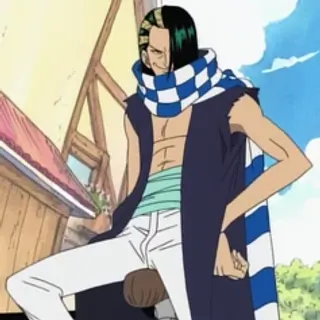
- Name
- カバジ (Kabaji)
- Status
- alive
- Affiliation
- Buggy Pirates
- First seen
- Ch. 15
First seenCh. 15Last seenCh. 593
“I don’t want to get rusty…! It’s been a while.” — Ch. 15, page 4
Profile
Officer-rank member of the Buggy Pirates. Captioned in Ch. 15 page 4 as “Buggy’s second mate.” Theatrical/acrobat fighting style — fights from atop a unicycle, holds a sword horizontally in his mouth between attacks, wears a long checkered scarf (black-and-white check). Kabuki-style white face paint with a small red dot under one eye. The chapter holds him in reserve — Buggy refuses to delegate the Boodle challenge, so Cabaji watches but does not fight.
Arc-by-arc updates
Loguetown (Ch. 99) — Visible with reconstituted Buggy Pirates at execution platform
- Visible with the Buggy crew at the execution platform / in the crowd.
- Part of the reconstituted Buggy Pirates lineup at Loguetown.
Cover-story (Ch. 55) — Buggy’s Crew After the Battle Part 15
Syrup Village cover-story (Ch. 36) — Cover-story Part Two: still on unicycle, carrying Mohji
- Cover-story Part Two appearance (page 1 splash, no main-story role). Cabaji is shown on his unicycle — still riding it post-defeat — carrying an unconscious Mohji over his shoulder, with Richie limping bandaged beside them, in a wrecked Orange Town street with a smashed Buggy Pirates jolly-roger banner. Caption “BUGGY’S CREW: AFTER THE BATTLE! PART TWO: MOHJI AND CABAJI.” See Buggy Crew Post-Battle Cover Story (new this chapter).
- Cabaji is the ambulatory survivor — Mohji is unconscious and Richie is limping, but Cabaji is upright and transporting. Implies Cabaji’s Ch. 17 Onigiri-cut was non-lethal and that his recovery was fast enough to be the one carrying Mohji. Confirms the Ch. 21 play-dead pact with Mohji has resolved into Cabaji-mobile, Mohji-still-down — a survival asymmetry visible in the cover-story splash.
Syrup Village cover-story (Ch. 30)
- Cover splash appearance (page 1) — sword visible, helping haul the Buggy figurehead-statue.
Volume-bonus paratext (Ch. 23)
- Appears in the Ch 23 page 20 volume-bonus Rough Sketch page. The page labels him “CABAJI THE ACROBAT” — making explicit the circus-discipline framing for Cabaji (an acrobat — consistent with his unicycle-and-flips combat style demonstrated in Ch 17).
Orange Town (Ch. 21)
- Confirmed alive (page 4) — survived Zoro’s Onigiri from Ch. 17. Shown crumpled in the rubble next to Mohji.
- Initiates the play-dead pact (page 4): “I think I’ll play dead a while longer.” / Mohji: “Good idea.” — first time Cabaji speaks post-defeat. The acrobat survives the first named santoryu technique used on a named target in the series and chooses to wait it out.
- No swordsman-pride defiance — the Ch. 17 “as one swordsman to another” fraternity-claim is silently retired. Cabaji’s response to losing is get small, wait, not rematch. Confirms the Ch. 16 read that swordsman-fraternity is a claim, not a property.
Orange Town (Ch. 17)
- Duels Zoro in the rubble of Orange Town’s main street through the entire chapter. Mocks Zoro’s injuries (“You injured yourself as insurance for your reputation… well, don’t worry… your wounds are severe. They’ll make an excellent excuse when you lose.”).
- Named-circus-trick attack vocabulary (pp. 7-9): “Dance of a Hundred Kamikaze Tops” (spinning-top barrage), “A Hike in the Mountains” (unicycle climb across rooftops/buildings), “Fireworks in the Cool Summer Breeze” (fire-breathing), “Sting of the Unicycle” (vertical unicycle-leap with sword extended). The circus-naming grammar mirrors Buggy’s clown-themed attacks (“Low-Flying Chop-Chop Cannon”).
- Tries to coordinate with Buggy mid-duel (p. 10): when Buggy fires the “Low-Flying Chop-Chop Cannon,” Cabaji shouts “With pleasure!” — implying he’d accept the assist. Luffy stomps Buggy’s head before the assist lands.
- Tries to break the duel by ramming Luffy (p. 11) — Luffy blocks and shouts “keep your mitts out of Zolo’s duel!” (p. 12). Cabaji: “I don’t need the captain to lend me a hand to kill YOU!!” — establishes Cabaji’s professional pride and his belief that he’s Zoro’s equal as a swordsman.
- Final unicycle-leap stab (p. 13) — fails as Zoro deflects in a single motion, dropping to a knee but not losing.
- Provokes Zoro’s reveal-line (p. 15): mocks Zoro as “anemic” — Zoro replies “You’ve got it wrong. What I’m tired of… is your stupid circus tricks!!!” Cabaji escalates “Very well! No more tricks! I’ll finish you now… with my REAL swordsmanship!!!” — and is felled on the next page.
- Defeated by Onigiri (p. 16) — the first named santoryu technique in the series uses Cabaji as its first on-page victim. Eyes wide, mid-air, SFX GIRI!!!. The chapter’s iconic visual.
- Survives the cut (off-panel; he is shown collapsed but the chapter doesn’t kill him).
- Cabaji’s defeat triggers Buggy’s despair monologue (p. 17): “Cabaji!!!! How could these common thieves have beaten us!?” — first time Buggy emotionally registers a crew loss. Establishes Cabaji as a named loss Buggy cares about, not just a mook.
- First named lieutenant to be defeated in active combat by the Straw Hats — the template for every later “captain’s right-hand-man duels Zoro” arc beat.
Orange Town (Ch. 16)
- First on-page name (in addition to Ch. 15 caption) — labeled “SECOND MATE” on p. 1 title triptych; named in Buggy dialogue (p. 5: “Cabaji! What’re you doing to Richie!?”); formally re-introduced via caption on p. 8 (“Buggy’s second mate, Cabaji the Acrobat!!”).
- Circus-tech repertoire established — unicycle (p. 5+); fire-breathing “Breath of Death” (p. 9); dust-cloud “Murder at the Steam Bath” (p. 11); misdirection-by-acrobatics throughout the duel.
- Swordsman fraternity claim (p. 9): “Roronoa Zolo, as one swordsman to another… It will be an honor to cut you down.” — then violates the claim on p. 11 by kicking Zoro’s wound. First on-page example of Oda’s framing rule: swordsman fraternity is a claim, not a property. Cross-link Worlds Greatest Swordsman.
- Misogyny-coded villain tell (p. 13): “What kind of man screams like a woman?” — small-bore-villain framing in a single line. Same structural beat Oda used for Helmeppo’s class-snobbery in Ch. 4.
- Cuts Zoro across the back (p. 13, KERWAP) — the duel’s apparent climax before Zoro pivots into the self-handicap.
- Exploits the captain-inflicted Ch. 15 wound (p. 9, thought balloon): “He couldn’t have healed yet from the wounds the captain gave him. I’m surprised he can even stand…” — Cabaji’s whole tactic is wound-targeting; reframed in Ch. 16 p. 16 when Zoro pact-renews via self-handicap and the duel pivots.
Orange Town (Ch. 15)
- First appearance + naming (page 4). Caption frame: “BUGGY’S SECOND MATE — CABAJI THE ACROBAT.” Same caption-nameplate visual grammar Oda uses for Buggy (Ch. 9 page 6) and Nami (Ch. 9 page 2).
- Volunteers to handle Mayor Boodle’s challenge for Buggy: “Leave him to me, sir.” / “I don’t want to get rusty…! It’s been a while.”
- Buggy refuses to delegate: “You stay out of this. Avast, fool! He challenged me!” — establishes Cabaji is the obvious second-mate matchup but is being held back for someone of higher rank to fight.
- No combat in this chapter. Stays on the sidelines through Buggy’s Devil-Fruit demonstration, Luffy’s re-entry, the trio composition, the Buggy Ball reflection, and the chapter’s payoff. Implicitly set up as the next matchup, likely against Zoro (officer-vs-officer parity).
- Reacts in surprise when Luffy bounces the Buggy Ball back: visible in the “AND HE BOUNCED IT BACK!!!!” reaction-shot strip (page 18).
Post-War — Buggy reunion (Ch. 593)
- Reunited with Buggy as “the chief of staff, Cabaji” (pp. 18–19).
Notes
- Name etymology: likely a play on kabuki (歌舞伎 — Japanese theatrical tradition) and/or kabaji / cabaret. The white face paint + theatrical staging supports the kabuki reading.
- Sword-in-mouth motif: shared with Zoro (Santoryu third-blade is held in mouth). Cabaji is positioned as a single-sword shadow of Zoro — same prop placement, theatrical-acrobat style rather than dedicated swordsman discipline. Visual rhyme set up for an officer-vs-officer Zoro fight.
- Confirms the Buggy Pirates have a formal officer hierarchy (captain → second mate); first time the crew’s rank structure is legible on-page.