Gum-Gum Gatling Debut Full-Page Composition Restaged Against A Yonko
Status: confirmed · Technique: visual-silhouette Confidence at time: fringe (composition echo — layout mirror, not a once-and-restaged unique silhouette)
The seed
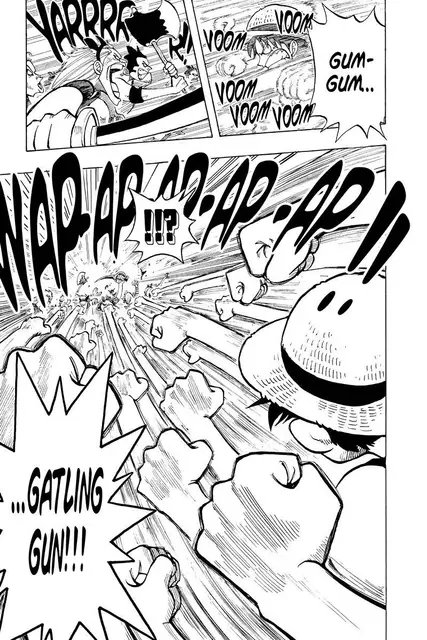
The payoff
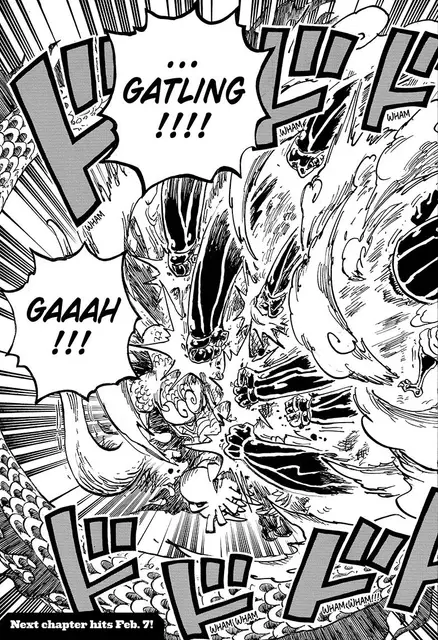
Why this matters
Gum-Gum Gatling recurs in 50+ chapters, so a generic Gatling panel is not a mirror. What makes this pair non-trivial is the bookend: Ch. 0030 p.11 is the very first on-page Gatling — a full-page panel against nameless hypnotised underlings — and Ch. 1002 p.17 restages that exact page-filling-radial-fist-fan composition against a Yonko. The layout signature (wielder shrunk to a corner anchor, limbs become the whole image, GATLING caption tucked in the opposite corner) is preserved across ~970 chapters; the only deliberate escalation in the frame is the target — from off-panel mooks to a full-size dragon-Emperor.
Watch-pattern: when a long-running named finisher gets a full-page (not inset-panel) restaging, read the target swap as the load-bearing change. Oda re-uses the established composition precisely so the reader’s eye measures the tier jump — the framing is constant so the opponent reads as the variable. Companion technique-lineage notes track the same escalation on the mechanical side (see cross-links); this note isolates the visual half.
Restaged twice more — the target ladder runs to the top
The 0030 ↔ 1002 bookend is not a pair — it is the bottom and middle of a ladder. Two further page-dominant restagings carry the identical signature (small Luffy anchored inside the frame · limbs become the whole image as a radial fist-fan · GATLING caption tucked in a corner away from the impact vector · colossal on-panel target · black slab-katakana ドド SFX ringing the edges):
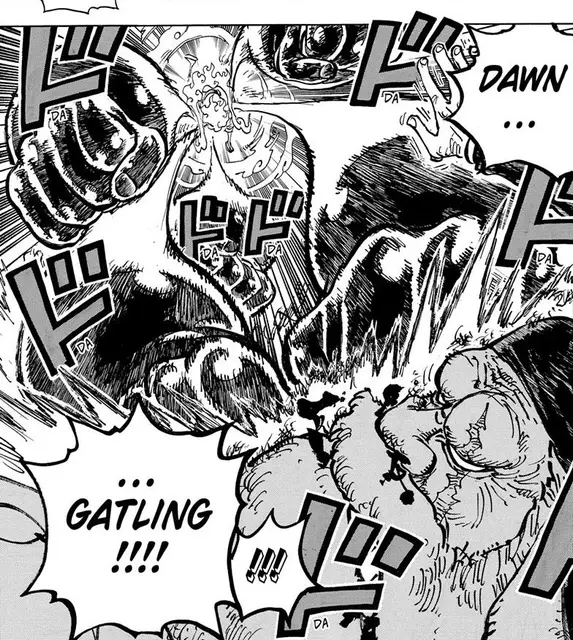
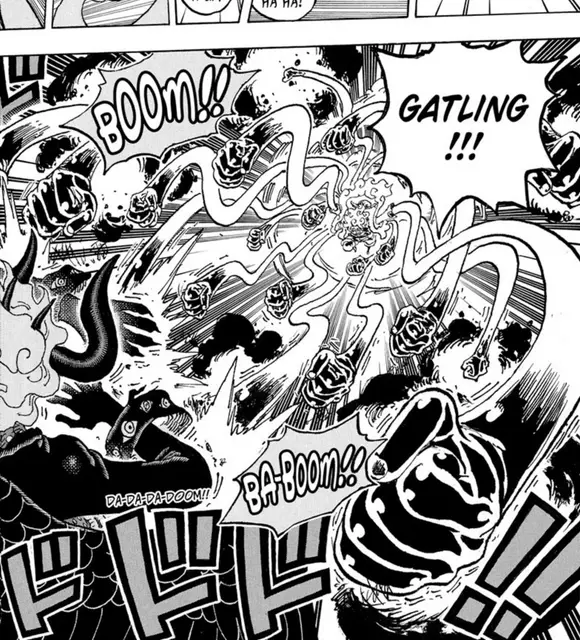
What this does to the reading. This note’s banked watch-pattern was: “when a long-running named finisher gets a full-page restaging, read the target swap as the load-bearing change.” Held across four rungs, the swap is a clean tier ladder and nothing else moves:
| Rung | Chapter | Target in frame |
|---|---|---|
| debut | Ch. 30 p.11 | hypnotised mooks — off-panel |
| Yonko | Ch. 1002 p.17 | Kaido, dragon form |
| Gorosei | Ch. 1107 p.11 | St. Jaygarcia Saturn |
| sovereign | Ch. 1192 p.6 | Imu, true form |
The one other variable that has moved is the arms: fists on straight stretched limbs for three rungs, then tentacles at 1192. The frame does not change, so the eye reads the tentacles as a property of the wielder’s escalation the same way it reads the target as a property of the opponent’s. Both halves of the panel have now been used as tier-meters.
Non-claims. The Gatling technique recurs constantly — Ch. 1178 (“Dawn Gatling”), Ch. 1188 p.8 (“Jet Gatling”) — but those are inset/middle-tier panels and are deliberately not counted as lineage members; only the page-dominant restagings are. No character scalar, no outcome, and no Imu-tier claim is advanced by this composition.
Cross-links
- Luffy — the wielder, corner-anchored in both panels
- Kaido — the Yonko-tier target of the restaged composition
- Gomu Gomu no Mi — the technique-tree
- Luffy Hypnotised Gatling Gun — the Ch. 0030 technique-debut lineage (mechanism side)
- Luffy Bullet Plus Gatling Stack — the technique-stacking / tier-installation lineage
- St. Jaygarcia Saturn — the Gorosei-tier target (Ch. 1107 rung)
- Imu — the sovereign-tier target (Ch. 1192 rung); Omen — the imps inside the fan
- Ch. 30 — seed · Ch. 1002 — payoff · Ch. 1107, Ch. 1192 — further page-dominant restagings