Kotori
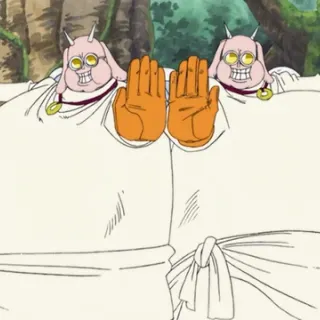
- Name
- コトリ (Kotori)
- Status
- alive
- Affiliation
- EnelHeavenly WarriorsUpper Yard
- First seen
- Ch. 261
Kotori of the Heavenly Warriors · alive · Heavenly Warriors
Profile
One of the triplet brothers of the priest Satori and, with Hotori, a sub-commander of the Heavenly Warriors (Enel’s God’s Army). Debuts beside Hotori on the Going Merry confronting Nami and Gan Fall.
Arc-by-arc updates
Skypiea — Upper Yard, defeated by Nami (Ch. 263)
- Shares the priests’ four-dial arsenal (Scent, Impact, Axe, Flame) and the “Surprise Dial Illusion” shell-game with his brother Hotori; notably wields a Flame Dial (burns the “Weird Knight” Gan Fall, who is unhurt).
- Defeated by Nami after she fogs the air with a Cool Ball + Fog Tempo to neutralize his Flame Dial and lands the Blue-Sea-iron gauntlet Impact (pp. 16-18). The twins cite avenging Satori (“first big brother Satori, now kid brother Kotori!”).
Skypiea (Ch. 261) — debut on the Going Merry
- Debuts beside Hotori on the Going Merry confronting Nami and Gan Fall, laughing and demanding vengeance for Satori.
- Self-introduces: “And I am Kotori! Our triplet was done in by you Blue Sea trespassers!” (p. 16).
Etymology
- Sound-motif: コトリ Kotori is a rhyme-sibling of Satori (サトリ = 悟り, Zen Buddhist “enlightenment” — confirmed for the triplet Satori, Oda SBS Vol. 29 p.46, where the religious-concept naming of Enel’s subordinates is discussed). Sa·tori / Ho·tori / Ko·tori is a deliberate -tori rhyme-set, reinforced by the shared “HO HO HO” laugh.
- Pun layer (speculative): コトリ = 小鳥 kotori, “small bird” — a fitting Oda joke for a winged sky-island warrior, but not SBS-confirmed for this character. Treat as a bonus reading; the sourced layer is the Satori-rhyme religious motif.
- Confidence: medium for the rhyme/religious-motif; the bird homophone is speculative.
- Sources: One Piece Wiki Satori page Trivia citing Oda SBS Vol. 29 p.46 (
onepiece.fandom.com/wiki/Satori,/wiki/Hotori_and_Kotori).
Notes
- ETYMOLOGY RESOLVED (medium): -tori rhyme-sibling of Satori (悟り; Oda SBS Vol. 29 p.46), with 小鳥 “small bird” as a speculative homophone bonus — see Etymology section. No SBS confirms the bird reading for this character.