Chouchou
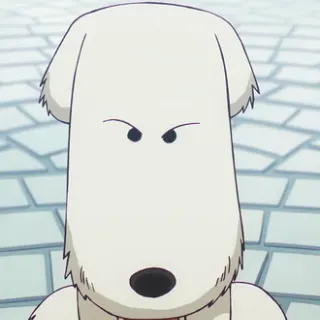
- Name
- シュシュ (Shushu)
- Status
- alive
- First seen
- Ch. 12
“Chouchou’s a smart dog… I think he knows his master is dead.” — Luffy, Ch. 12 page 14
Profile
Small white terrier-style dog (the breed-coding is closest to a Sealyham or West Highland White). Permanent guardian of the Pet Food shop on a side-street in Orange Town.
Backstory delivered in Ch. 12 pages 12-15 (told by Mayor Boodle):
- The shop’s owner was Boodle’s friend; opened the Pet Food store ~10 years ago. Chouchou was with him from the start.
- Three months before the chapter, the owner fell sick and went to the hospital. He died there.
- The townspeople lied to Chouchou and said his master is still at the hospital. Boodle believes Chouchou knows the truth but guards the shop anyway because “it’s his treasure… because it’s all that’s left of his beloved master.”
Chouchou is the chapter’s emotional center despite no plot agency — he doesn’t bark for help, doesn’t follow anyone, doesn’t react to Mohji’s roar. Loyalty-to-dead-master is his entire character beat. Seeds the Loyalty to Dead Master Pattern (animal-companion-as-emotional-mirror) that recurs across the series.
Functions as the chapter’s parable figure in Ch. 13 — see Chouchou Treasure Parable.
Arc-by-arc updates
Orange Town (Ch. 21)
- Second on-page appearance (pages 9-10) after the Ch. 12-13 introduction. The dog actively intervenes on the Straw Hats’ behalf by physically blocking his own townspeople from passing through the alley.
- Stewardship-judgement made operational — the Ch. 13 parable predicate (loyalty follows stewardship, not affiliation) is here extended past the Pet Food shop to the people who saved his neighborhood. Chouchou growls at his own townspeople. Composition mirrors his Ch. 12 page-21 growling shot but with inverted threat-direction. Strengthens Chouchou Treasure Parable — the parable’s predictive payload is shown to govern future action, not just retroactive interpretation.
- Luffy’s silent reaction shot (page 10, ”…”) is the chapter’s emotional pivot — wordless acknowledgement that the dog understood and is paying it forward.
- No bark for help, no follow — Chouchou holds his post in the alley. The guardian-stays-put axiom from Ch. 12 holds. After the trio escapes he is presumably back at the Pet Food shop’s rubble (off-page).
Orange Town (Ch. 14)
- At the refugee camp (page 4): limps into the “Refuge of the Townspeople” wounded after fighting the Buggy Pirates. Villagers: “He’s hurt bad. Cursed pirates! Let’s take care of his wounds.” (Note: this beat reframes how Chouchou’s earlier Ch 12-13 storyline fits — the wounded dog made it back to the off-walls evacuation camp.)
- Established as moral exemplar (page 7): Boodle credits Chouchou — “after the way Chouchou and this kid fought back so bravely” — as half the reason Boodle himself decides to stand up to Buggy. The dog is set up as a moral example to a human. Reinforces Chouchou Treasure Parable.
- Implicit storyline link — Boodle had gone to feed Chouchou when separated from the townspeople, anchoring the page-4 missing-persons beat.
Orange Town (Ch. 13)
- Survives the destruction of the Pet Food shop in the Luffy-vs-Mohji-and-Richie fight; the shop is reduced to rubble during the chapter.
- Luffy salvages one undestroyed box of pet food from the rubble for him (page 18).
- Chouchou trots away with the pet-food box clamped in his teeth (page 19) — single-shot composition that is a visual prop-rhyme with Luffy carrying the straw hat. Catalyst for Nami’s first on-page beat of moral re-evaluation of Luffy (Ch. 13 page 18 “ULP!” reaction shot).
- The Chouchou chapter codifies Oda’s treasure-as-stewardship thesis — see Chouchou Treasure Parable.
Orange Town (Ch. 12)
- First appearance (page 6) — first introduced as a deadpan motionless lump in front of the shop (“WHAT’S WITH YOU, DOG?” “DOG? HEY, A DOG!”). Visual gag: looks dead.
- Bites Luffy (page 7) when poked. The CHOMP / YOW slapstick is the chapter’s mid-tone setpiece.
- Eats the cage-key (page 9) — CHONK / SKRNCH. Triggers the entire chapter’s later plot complication: with the key in his stomach, the rescue from the cage is stalled.
- Backstory delivered third-person (pages 12-15) — told via Boodle. Chouchou himself is silent across the entire backstory sequence; his only action is to eat from his food bowl mid-paragraph (page 14 panel 1: CHOMP CHOMP). The detail of the dog continuing to eat during the eulogy is the chapter’s emotional dryness — Oda refuses to anthropomorphize the grief.
- Stays put when Mohji approaches (page 15) — does not flee, does not bark for the running townspeople. Loyalty stronger than self-preservation.
- Sits between Luffy and the Pet Food shop in the final pages — when the shop is threatened by Mohji’s lion, Chouchou’s posture changes from sit-deadpan to growling (page 18 GRRR… ; page 21 “What’s wrong…?” SNFF SNFF). The full-page Chouchou-growling reaction shot (page 4 reverse / page 21) is structurally set up to pay off in Ch. 13 when the shop comes under direct attack.