Yasuie Execution Platform Mirrors Roger Execution Scaffold
Status: confirmed · Technique: visual-silhouette + parallel-arc-structure + panel-composition-quotation
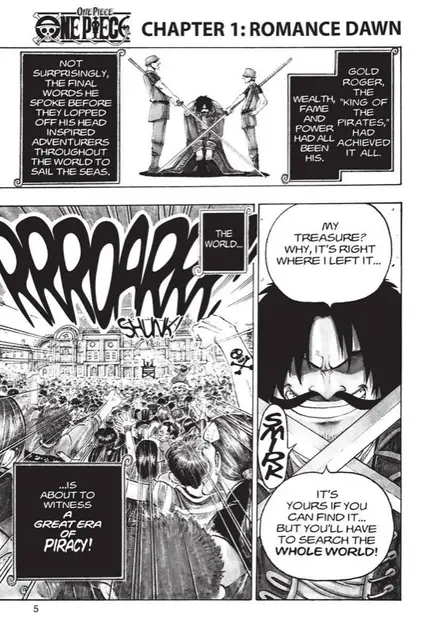
The seed
The payoff
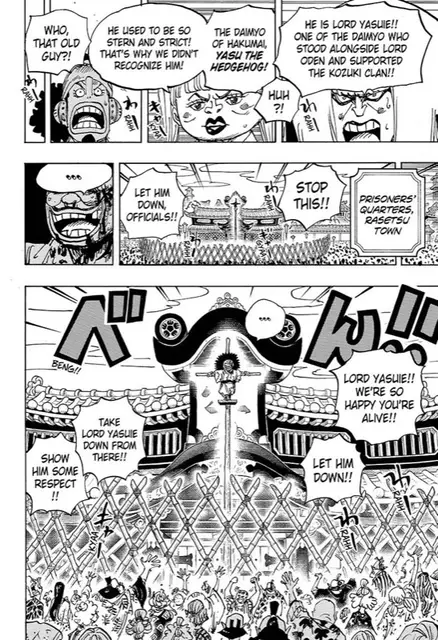
The structural match is the condemned-figure-elevated-dead-center + raised-public-execution-platform + vast-crowd-below + low/up camera spectacle grammar of Roger Ch. 1 p. 1. The specific rendering varies — Yasuie is crucified arms-spread on a cross rather than bound between two crossed blades — but it sits squarely inside the execution-platform composition lineage the vault already tracks: Roger (Ch. 1) → Luffy survives the inversion (Ch. 100) → Noland (Ch. 292) → Ace (Ch. 549/550) → Yasuie (Ch. 941, Wano).
Why this matters
This is the Wano instance of Oda’s public-execution-platform composition — the recurring grammar for “the condemned man whose truth outlives the verdict.” Three things weld Yasuie into the Roger lineage rather than reading the panel as a generic crucifixion:
-
The condemned-truth-teller theme. Roger (a “criminal” who left the world the One Piece), Noland (a “liar” who actually found the City of Gold), and Yasuie (a “thief” who is in truth a loyal Kozuki-allied daimyo) are all figures the ruling power brands false and executes in public — and whose words at the platform change the world afterward. Yasuie’s parting speech the following chapter is staged as exactly this Roger-class final-words beat.
-
The crowd-inversion completes the set. The composition keeps the same staging but re-keys the crowd’s register each time: Roger’s crowd is awed (“about to witness a great era of piracy”), Noland’s crowd jeers (“LIAR!! LIAR!!”), and Yasuie’s crowd grieves with love (“we’re so happy you’re alive!!”, “let him down!!”). The crowd is the variable the composition uses to carry the semantic load — here, that the people know the regime’s verdict is a lie.
-
It co-fires with the laugh-tell. On the very next page Yasuie vows “I intend to go into the great beyond LAUGHING!!” — the King-of-the-Pirates laugh-at-one’s-own-execution grammar (see Pirate Laugh Before Execution Mythic Doctrine). The scaffold composition and the laugh tell land together on the same character at the same platform, exactly as they do for Roger at Ch. 1 / Ch. 99–100. Yasuie is the only figure since Roger/Luffy to carry both halves of the grammar.
When a near-half-page-or-larger panel stages a condemned public figure elevated dead-center on a raised platform over a crowd, check it against the Roger set (Ch. 1 → Ch. 292 → Ch. 549/550 → Ch. 941) before reading it as generic — and read the crowd’s register and whether the condemned laughs as the two dials that tell you which beat of the grammar it is.
Distinct-but-adjacent
- The specific two-symmetric-flankers / crossed-blades-X sub-grammar of the Roger panel (Roger Execution Scaffold) is not literally quoted here — Yasuie is crucified, not flanked. This is the broader platform-spectacle match, not the narrow flanker match. Keep that honest.
- The laugh-tell (Pirate Laugh Before Execution Mythic Doctrine) is already filed with its own Yasuie @0941 evidence; this note is the companion visual-composition mirror, kept separate the way the Noland note keeps the composition separate from the laugh.
Cross-links
- Roger Execution Scaffold — the parent execution-platform composition note (Roger ↔ Luffy ↔ Noland ↔ Ace); this is its Wano instance
- Noland Execution Scaffold Mirrors Roger Execution — the closest prior sibling (condemned “liar” / crowd-inversion)
- Pirate Laugh Before Execution Mythic Doctrine — the co-firing laugh-tell at the same panel
- Panel-Composition Quotation Technique — the technique anchor
- Tonoyasu’s Name Encodes His Hidden Lordship — the identity-reveal the execution stages
- Tonoyasu · Roger · Toko