Brook Alone On The Rumbar Decks High-Angle Empty-Deck Composition
Status: confirmed (visual mirror) · Technique: visual-silhouette / composition-rhyme
The seed
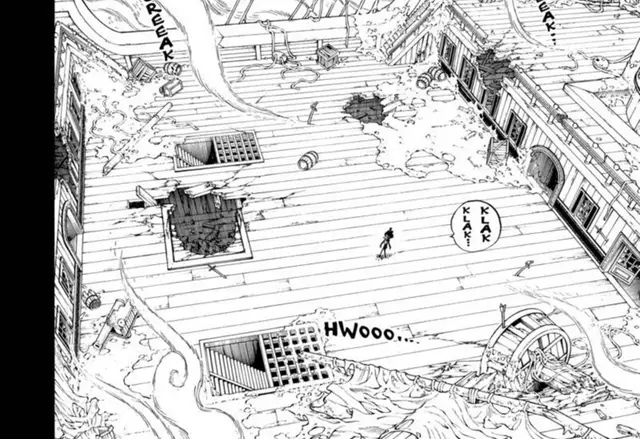
High-angle wide shot looking down onto the planked deck of the deteriorating Rumbar ship adrift in the fog. The deck is vast and emptied; a single tiny lone figure (Brook) stands near the center, dwarfed by the space, debris and shattered fixtures scattered across the boards (
KREEK… / KAT KAT… / HWooo…). The composition reads as isolation made spatial — one survivor on an oversized, lifeless deck. The chapter note already flags it: “the deteriorating Rumbar ship adrift; lone figure on deck.”
The payoff
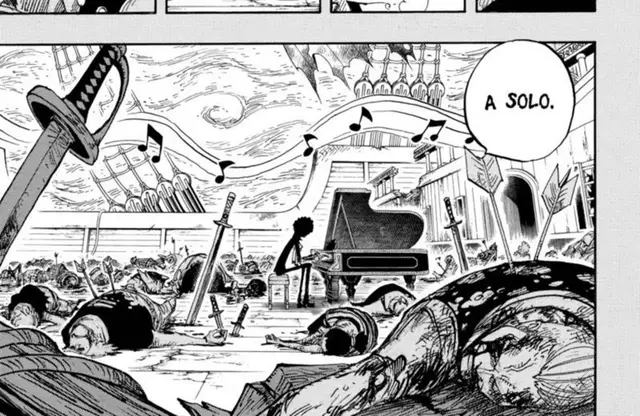
One chapter later, Oda re-runs the identical camera: the same high-angle wide shot, looking down onto the same Rumbar deck, with Brook the lone living figure at the center — now seated at the piano, playing the final solo of “Bink’s Sake” while his entire crew lies dead around him (a katana stuck upright in the foreground, the corpses strewn where the band once stood, music notes drifting up). The band has thinned quartet → trio → duet → “A solo,” and the panel resolves on the same empty-deck framing the reader first met three in-story years on. This is the moment that created the Ch 487 image: the deck emptied here.
Why this matters
This is Oda’s before/after composition-rhyme: the same high-angle empty-deck framing is used twice to bookend Brook’s tragedy. In reading order the reader meets the haunting aftermath first (Ch 487, p12 — Brook already alone, ship rotting) and only one chapter later is shown the cause (Ch 488, p17 — the death-solo over the corpses). The recurring “lone Brook on the vast empty deck” framing is the visual through-line of his entire backstory, and it is the same isolation grammar Oda will pay off at his present-day debut as the lone skeleton on the ghost ship (Ch. 442).
Watch-for heuristic: when a flashback opens on an unexplained desolate-wide-shot of a lone figure, watch for the same camera to return later with the scene populated — the empty frame is usually withholding a death the later panel will deliver. A re-used high-angle on the same set, lone-figure-centered, is the tell.
Cross-links
- Brook
- Rumbar Pirates
- Florian Triangle
- Ch. 442 — Brook’s present-day debut: the same lone-skeleton-on-a-death-ship isolation, 50 years on.
- Brook’s Tone Dial Holds The Rumbar Pirates’ Final Song For Laboon
- Calico Yorki’s Unknown Fate After Splitting From The Rumbar Pirates